Wisconsin Army National Guard Aviators leave for Afghanistan Mission

March 13, 2018

180309-Z-ON199-0015

YELLOW RIBBON AMERICA NEWS DESK:

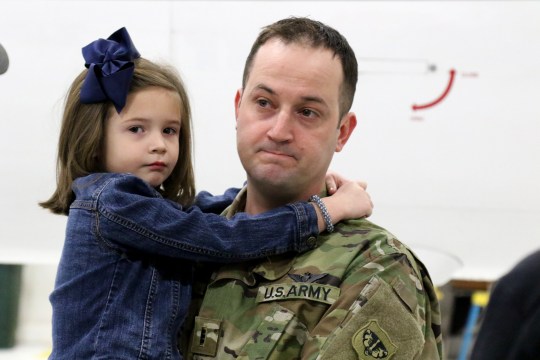
Photo: Chief Warrant Officer 3 Billy Dart, a pilot with Detachment 5, 641st Aviation, Operational Support Airlift, holds his daughter at a sendoff ceremony in Madison, Wis., Mar. 9. Dart and two other C-26 pilots will complete pre-deployment training at Fort Bliss, Texas, and join members of the Hawaii National Guard before deploying to Afghanistan. They will fly a C-26 airplane to transport critical personnel throughout the Afghanistan theater of operations and the surrounding region in support of Operation Freedom’s Sentinel. Wisconsin National Guard photo by Sgt. Katie Eggers

Wisconsin Army National Guard Aviators leave for Afghanistan Mission

by Sgt. Katie Eggers

MADISON, Wis. — Three Wisconsin Army National Guard pilots bid farewell to their families Mar. 9 at a small sendoff ceremony before leaving for Fort Bliss, Texas, where they will complete pre-deployment training prior to heading to Afghanistan.

The Soldiers of Detachment 5, 641st Aviation, Operational Support Airlift, based out of Army Aviation Support Facility 2 in Madison, Wisconsin, will join up with Hawaii National Guard C-26 aviators to transport critical personnel throughout Afghanistan and the surrounding region in support of Operation Freedom Sentinel.

“It’s a hard day saying goodbye to your Soldiers,” said Command Sgt. Maj. Rafael Conde, the Wisconsin Army National Guard’s senior enlisted leader, to the families in attendance. “Certainly they are well trained. They are very professional. They’re ready to do their mission, but it’s always tough for the families seeing them go.”

Maj. Gen. Mark Anderson, Wisconsin’s deputy adjutant general, echoed Conde’s sentiments, and agreed that these Soldiers are ready for their mission.

“I’ve had the pleasure, and the honor, and the privilege to ride with these gentlemen multiple trips around the country,” Anderson said. “Their professionalism, their capabilities, their competence as pilots is second to none.”

Anderson mentioned that the deploying Soldiers have more than 29,000 flying hours logged between them.

Maj. Gen. Don Dunbar, Wisconsin’s adjutant general, said it was extraordinary to have that level of experience.

“I can tell you that there is nobody better prepared to go overseas than these three soldiers right here,” he added.

“We do this mission every day of the week,” said, Chief Warrant Officer 3 Billy Dart, one of the deploying pilots. “We fly a lot. We fly all over the country, so this’ll really be no different except for we’ll be in a combat zone.”

This will be Dart’s second deployment. He deployed in 2011 to Iraq doing a similar mission flying UH-60 Black Hawk helicopters instead of the C-26 airplane he will be flying in Afghanistan.

This is also the second deployment for Chief Warrant Officer 5 Arthur Hebblewhite, who was in Afghanistan in 2014 performing the same mission. While he felt ready to go, he also said it was a bittersweet day having to say goodbye to his family.

Dunbar took time to talk to each of the families before the sendoff ceremony began, personally thanking each of them for their sacrifice.

“I see the pride you all feel in these Soldiers and what they do for our country,” Dunbar said during the ceremony.

Hebblewhite’s wife, Rebecca, said it is hard to say goodbye even when you’ve been through it before. Still, she is proud of her husband and his unit.

“Their unit does a phenomenal job, and they always do everything that’s necessary to go above and beyond,” she said.

The Wisconsin National Guard remains heavily engaged fulfilling its mission as a key component of the primary combat reserve of the Army and Air Force. Three other Wisconsin Army National Guard aviators from Detachment 5 deployed to Afghanistan in November, and Soldiers from the 248th Aviation Support Battalion deployed to the Middle East in September. Approximately 85 Soldiers with 1st Battalion, 147th Aviation returned from a nine-month deployment to the Middle East in January, and approximately 35 Soldiers from West Bend’s Company C, 1st Battalion, 168th Aviation returned from a nine-month deployment to Afghanistan in November.

Also in November, approximately 270 Airmen from the 115th Fighter Wing returned to Madison from a deployment to Korea. Approximately 70 Airmen from the 128th Air Refueling Wing in Milwaukee are in the midst of deployments worldwide, and other Airmen from the 128th deployed earlier in the fall as well. Last spring, approximately 120 Soldiers from the 32nd Military Police Company returned from a deployment to U.S. Naval Station Guantanamo Bay, Cuba.

Meanwhile, the Wisconsin National Guard has been busy fulfilling its other mission as the state’s first military responder in times of emergency. Last fall, the Wisconsin National Guard deployed Soldiers and Airmen to Florida, Puerto Rico and the U.S. Virgin Islands to assist with hurricane recovery efforts, and Soldiers responded on multiple occasions to flooding over the summer in Monroe County and Burlington, Wisconsin.

– 30 –

USCGC Gerczak (WPC 1126) arrives to New Homeport of Honolulu!

February 6, 2018
180204-G-IA651-659
Yellow Ribbon America News Desk:
 
The crew of the Coast Guard Cutter Joseph Gerczak (WPC 1126) prepare to moor at their new homeport of Honolulu Feb. 4, 2018, following a 42-day transit from Key West, Florida, where the cutter was delivered. The Gerczak is the second of three 154-foot Fast Response cutters to arrive to Hawaii.

Selfless American Soldier Sacrificed Himself for Member of His Unit

January 30, 2018

This blog is part of a weekly series called “Medal of Honor Monday,” in which we’ll highlight one of the nearly 3,500 Medal of Honor recipients who have earned the honor of wearing the U.S. military’s highest medal for valor.

In June of 2006, the 3rd Squadron of the 71st Cavalry Regiment (Recon), 3rd Brigade Combat Team, 10th Mountain Division, prepared to execute Operation Gowardesh Thrust, a squadron-sized operation in the Gremen Valley, Nuristan Province, Afghanistan.

The operation was designed to disrupt enemy operations in the Gremen Valley by denying the enemy freedom of movement and the use of critical staging areas near the border with Pakistan. The initial phase of the operation required a 16-man patrol to infiltrate into the area of operations in advance of the squadron’s main effort.

The patrol, consisting of snipers, forward observers and scouts, would maneuver north along a high ridge overlooking the Gremen Valley. From the high ground of the ridge, the patrol would provide real-time intelligence and help direct fires against enemy forces.

On the evening of June 17, 2006, a convoy transported the patrol to an established mortar firing position south of the village of Baz-Gal near the Gowardesh Bridge. The following morning, the patrol infiltrated on foot from the mortar firing position into their area of operation. For three days, the patrol moved north through rugged mountain terrain. Due to the difficulty of the climb and temperatures near 100 degrees, the patrol moved mostly at night or in the early morning hours, stopping during the heat of the day to observe the valley below.

On June 20, the patrol leaders, Staff Sgt. Christopher M. Cunningham and Staff Sgt. Jared C. Monti, the son of a teacher and nurse who grew up just outside Boston, halted the patrol on the ridgeline of a mountain northwest of the village of Gowardesh.

Cunningham and Monti selected a flat area on top of the ridge approximately 50 meters long and 20 meters wide, with a trail running along the eastern edge. At the southern end of the position, there were several large rocks, a portion of an old stone wall and a few small trees. The terrain sloped gradually upward to the north. At the northern end of the patrol’s position there was a line of dense vegetation composed of trees, heavy brush and smaller rocks. In between the large rocks to the south and the tree line to the north was a clearing approximately 40-50 meters in length. The terrain dropped off steeply on the eastern and western sides of the position. The rocks and trees around the position provided concealment and protection for the patrol as they observed the valley more than 1,000 meters below.
The patrol spent the night of June 20 observing from their position on the mountain. The following morning the patrol was dangerously low on both food and water. A re-supply mission was scheduled for that day. The re-supply was originally coordinated to occur in conjunction with the squadron’s main effort, which included a large air assault into the Gremen Valley. The heavy helicopter traffic associated with the air assault mission would have provided distraction for the re-supply, reducing the risk that the drop would compromise the patrol’s position. However, on the morning of June 21, Monti and Cunningham learned that the squadron operation had been pushed back until June 24. The delay extended the patrol’s mission by several days, making re-supply critical; however, the absence of other aerial traffic increased the risk that the re-supply would compromise the patrol. Because of the critical shortage of water, it was determined that the re-supply would go forward as planned despite the risk of compromise.

The drop zone was located about 150 meters from the patrol’s position. Cunningham and Monti brought the majority of their patrol to the re-supply drop zone to provide security and to transport the supplies back to the patrol’s position. A smaller group remained at the observation position to provide security and to continue to survey the valley below. At about 1:30 p.m., a UH-60 Black Hawk delivered food and water to the patrol. The patrol secured the supplies and began taking them back to their observation position.

Spc. Max Noble, the patrol’s medic, was one of the soldiers who remained at the observation position while the majority of the patrol picked up the re-supply. Noble was using a spotting scope to look down into the valley. Prior to the patrol’s return from the re-supply drop, Noble saw a local man in the valley using military-style binoculars to look up toward the patrol’s position. Noble informed Cunningham and Monti as soon as they returned. They watched the man observing the patrol’s position for several minutes before he picked up a bag and walked away.

As dusk approached, the patrol established a security perimeter around their position and scheduled guard rotations. The patrol members then divided up the supplies and prepared for the night. Cunningham and Monti sat behind one of the large rocks at the southern end of the patrol’s position and discussing courses of action in the event that their position had likely been compromised.

At about 6:45 p.m., a member of their unit heard the shuffling of feet in the wood line immediately to the north. Before he could react, the patrol’s position was hit by a barrage of rocket-propelled grenades (RPGs), medium machine gun fire and small-arms fire from the wood line. An enemy force of approximately 50 fighters was moving in under cover from two support-by-fire positions above the patrol to the north and northwest. Members of the patrol could hear enemy fighters giving commands as they moved through the wood line at the northern end of the patrol’s position.

At the time of the attack, the six patrol members at the northern end of the patrol’s position immediately dove for cover as the enemy opened fire. The attack came so quickly and with such ferocity that many of the patrol members at the northern end of the position were unable to maneuver to get to their weapons. Others had their weapons literally shot out of their hands by the intense fire

From behind the rocks at the southern end of the patrol’s position, Monti and Cunningham returned fire, attempting to cover for the patrol members falling back from the north. However, the intensity of the enemy small arms fire and frequent volleys of RPGs made it dangerous for the patrol members to expose themselves in order to accurately aim their return fire.

As the patrol fell back behind the large rocks, Cunningham and Monti took charge of the defense. They quickly set up a perimeter, posting soldiers to guard potential approaches on their flanks. They directed return fire and cautioned their soldiers to control their fires to conserve ammunition. Monti grabbed his radio handset and cleared the network to call for fire. He calmly informed headquarters that the patrol was under attack, heavily outnumbered and at risk of being overrun.

While still communicating with the squadron headquarters and under intense fire, Monti periodically dropped the handset to engage the enemy with his rifle. At one point, he noticed a group of fighters closing in on the western flank and disrupted their attack with several bursts from his weapon. As the enemy closed within 10 meters of the patrol’s defensive perimeter, Monti threw a grenade into their path. Although the grenade was inert, its presence disrupted the enemy advance and caused them to scatter and fall back, denying the enemy a position on the patrol’s flank. Monti then went back to the radio and continued to call for support.

At this time, the initial volley of mortar fire began to fall on the advancing enemy, driving them back to a wood line north of the patrol’s position. The mortar firing position asked Monti to adjust the incoming rounds; however, the enemy fire from the wood line was so extreme that Monti was unable to even raise his head up to observe the incoming rounds.

As the enemy was driven back into the wood line, Monti and Cunningham took accountability of their soldiers. They quickly realized that one soldier, Pfc. Bradbury, was unaccounted for. Monti called for Bradbury several times and received no response. Finally, over the din of near constant enemy fire, they heard. Bradbury weakly reply that he was badly injured and unable to move.

Bradbury, who was a SAW gunner on Monti’s team, lay severely wounded in a shallow depression approximately 20 meters in front of the patrol. The shallow depression prevented the patrol from actually seeing Bradbury, but it also protected him from the enemy, just 30 meters away.

Monti recognized that Bradbury was not only exposed to enemy fire, but also to the incoming indirect fire. He called out to Bradbury to reassure him that he would be alright and that they were coming to get him. Cunningham yelled across the rocks to Monti that he would go for Bradbury. However, Monti insisted that Bradbury was his soldier and that he would go and get him.
Monti then handed the radio handset to another soldier and said, “You are now Chaos three-five,” which was Monti’s call sign. After tightening down his chin strap, Monti, without hesitation or concern for his own safety, moved out from behind the protection of the large rocks into the open and into the face of enemy fire.

The wood line immediately erupted as dozens of enemy fighters focused their fire on Monti, running towards his wounded soldier. Repeatedly hindered by enemy fire, and timing his movement to the sound of the exploding rounds, Monti, for a third time, rose from his covered position and moved into the open, knowing he again would be the focus of the enemy fire.
On his third attempt, Monti took several lunging steps through withering fire towards his wounded soldier before an RPG exploded in his path. Before he could reach cover, Monti fell mortally wounded only a few meters from Bradbury. Monti attempted to crawl back towards the stone wall, but was unable to move far due to the severity of his wounds. The patrol called out to Monti and tried to encourage him to remain conscious. Monti spoke briefly with the members of the patrol, telling them that he had made his peace with God. He then asked Cunningham to tell his parents that he loved them. Shortly thereafter, he fell silent.

Bradbury, critically injured and weak, was eventually reached by medics, but the cable hoisting him into the safety of the helicopter broke and he fell to his death, as did Noble, the unit medic assisting him.

Monti was posthumously promoted to sergeant first class on June 22, 2006. He was awarded the Medal of Honor by President Barack Obama on Sept. 17, 2009.
Log Car from Williams Lake, B.C., fuels multiple bids on the Barrett Jackson Auction Block!

January 23, 2018

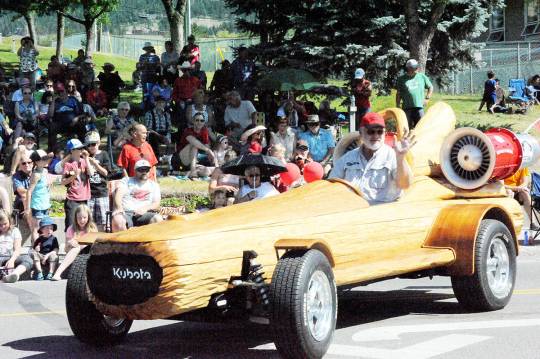
IMG_0891‘It’s the most expensive log we’ve ever sold’: Pioneer Cedar Rocket at Barrett Jackson Auction brings crowd to its feet!

Jenifer Norwell · CBC News: January 22nd 2018

It was ‘pandemonium’ as the so-called Pioneer Cedar Rocket was sold at the Barrett Jackson Auction in Scottsdale, Arizona.

The log car was created out a single piece of red cedar. (Barrett Jackson/Facebook)

A record-breaking log car made in Williams Lake was sold not once, but three times on Friday!

The so-called Pioneer Cedar Rocket was created by Pioneer Log Homes of B.C., from a single log and holds a place in the Guinness World Records for fastest log car.

The log car has been toured all around North America for the past two years before being put up on the auction block at the Barrett Jackson Auction in Scottsdale, Ariz.

‘Sell it again’

It was auctioned off on Friday night to raise money for veterans organizations in the U.S. and Canada.

The car first sold for $175,000 US. That’s when the buyer told the auctioneer to sell the car again so more money could be raised.

“When he said, ‘sell it again’ it was like, you’ve gotta be kidding,” said Bryan Reid Sr., the creator of the car and co-owner of Pioneer Log Homes.

The car was sold a second time — this time for $100,000 US.  That’s when the next buyer did the same thing as the first buyer and the car went back on the auction block.

“The crowd was crazy. Everybody was on their feet. It was just total pandemonium,” said Reid.

When it finally sold for a third and final time, the buyer paid $75,000 US — raising $350,000 US in total, or just over $436,000 Cdn, for charity.

“It was a relief to know it went for enough to make a difference to these organizations,” said Reid.

“We’d have been happy at $100,000, I mean that’s a substantial amount of money and why would somebody pay that for a log on wheels?”

Reid says the final buyer was a man from a museum in Virginia Beach, Va., and the car will be displayed next to the Batmobile.

“It’s the most expensive log we’ve ever sold!”

Pioneer Log Homes Cedar Rocket rolls onto 2018 Scottsdale Barrett-Jackson Auction Block!

January 6, 2018

10055355_web1_180105-WLT-Log-Car-Going-to-Auction_2

The World’s Fastest Log Car will be go to the highest bidder at the Barrett-Jackson Auction in Scottsdale, Arizona later this month.

By Monica Lamb-Yorski, Jan. 5, 2018

Two years after emerging as the World’s Fastest Log Car, the Cedar Rocket is fulfilling its Williams Lake creators’ dream and will be auctioned this month to raise money for veterans groups.

“Often coined as the world’s most eco-friendly car, totally handcrafted over thousands of hours and inspired by the renewable resource of Mother Nature, this exclusive combination of electric, turbine and conventional wheel drive, is an example of ingenuity and a testament to the ability to create,” Bryan Reid Sr., founder and owner of Pioneer Log Homes of B.C. told the Tribune.

Reid and his long-time friend Gerald Overtron Sr., designed the car together, using a single section of a Western Red Cedar harvested near Bella Bella, B.C.

Last week Reid left Williams Lake to take the log car to Barrett-Jackson Auction Company in Scottsdale, Arizona where it will be sold to the highest bidder on Friday, Jan. 19.

From the very beginning, it was always the intention to donate 100 per cent of the auction proceeds exclusively to veterans groups, including the Royal Canadian Legion, the National Medal of Honor Museum Federation and Our Nations Heroes Foundation, Reid explained.

Asked if he is sad to give it up, he responded with an emphatic “no.”

“It’s an honour to give it up,” he said. “It’s exciting to see it go for such a good cause.

That is what is was originally designed for, that’s why I went to some of the most high profile shows in North America with it. Pioneer doesn’t need the advertising, we’ve got all the work we can handle.”

Reid described the Barrett-Jackson Auction as the largest and most prestigious auction in the world, adding he has attended it for 16 years.

“There’s everything there from classic to muscle cars, European cars, luxury cars, anything you can imagine.”

In 2016, Guinness World Records affirmed the Cedar Rocket set a new world record for the fastest motorized log after Reid drove it at the Wild Horse Pass Motorsports Park in Chandle, Arizona on Jan. 20, 2016.

He achieved 76.625 kilometres an hour, which Guinness said was impressive, especially because of the car’s weight.

Aside from the log, the vehicle contains metal frames and axels, an electric motor, lead gel batteries stored in the nose and two turbines.

Thank You America! For Your Heartfelt Support OF America’s Best & Their Families This Christmas!

December 30, 2017

2006 OP Christmas (3)OCFTFV SAC 1YRA OCFOT&FV 11-1-08 180 (3)IMG_5714Op Christmas USMC Miramar 62YRA OCFOT&FV 12-15-08 19310407932_10205108242810840_2894613530847318154_nMerry-Christmas-Wallpaper-2014

Support America’s Best This Christmas!

December 20, 2017

Santa Clause preparing

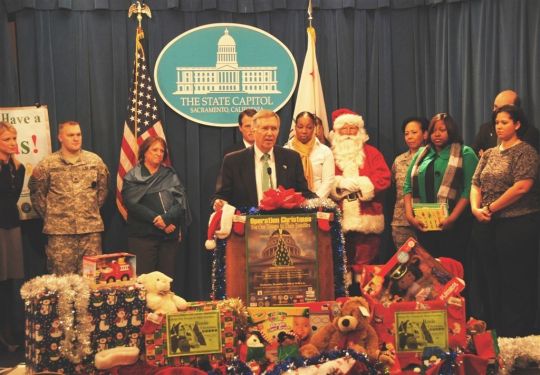
Join me and my Great Elves with “Operation Christmas For Our Troops & Their Families“. Help American’s Local Military Unit’s & Their Families this Christmas! 

Contact my Elves at Yellow Ribbon America their website is http://www.YellowRibbonAmerica.org.

Thank you and Merry Christmas!

The Christmas Season Is Here!

November 24, 2017

tumblr_mthilqcoh21sd6etno1_1280

Support America’s Best This Christmas!

November 20, 2017

OpCFOT-XIII-2017

Make a Difference Today!

The Vital Community relationships that Yellow Ribbon America helps bring together during the Christmas Holiday Season help America’s Military Units and their families get Vital Community Support Year Round! This is the whole reason the Yellow Ribbon America Campaign for America’s Military & their Families and Operation Christmas For Our Troops & Their Families was created!

The BEST Support is Local Community Based Support!

Merry Christmas!

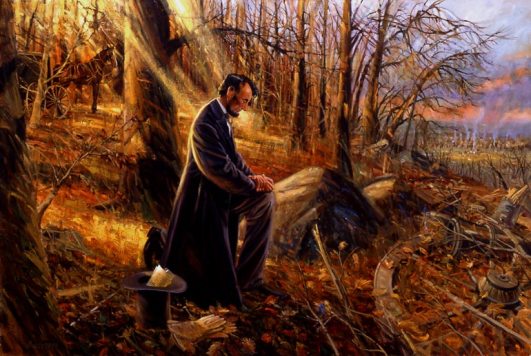
President Lincoln’s Proclamation of Thanksgiving!🇺🇸

November 13, 2017

lincolnthanks

1863 President Lincoln’s Proclamation of Thanksgiving

Celebrated shortly after Lincoln committed his life to Christ, and celebrated while America was still in the midst of its Civil War. It was this proclamation which eventually led to the establishment the U.S. national Thanksgiving holiday.

This is the proclamation which set the precedent for America’s national day of Thanksgiving. During his administration, President Lincoln issued many orders similar to this. For example, on November 28, 1861, he ordered government departments closed for a local day of thanksgiving.

Sarah Josepha Hale, a 74-year-old magazine editor, wrote a letter to Lincoln on September 28, 1863, urging him to have the “day of our annual Thanksgiving made a National and fixed Union Festival.” She explained, “You may have observed that, for some years past, there has been an increasing interest felt in our land to have the Thanksgiving held on the same day, in all the States; it now needs National recognition and authoritive fixation, only, to become permanently, an American custom and institution.”

Prior to this, each state scheduled its own Thanksgiving holiday at different times, mainly in New England and other Northern states. President Lincoln responded to Mrs. Hale’s request immediately, unlike several of his predecessors, who ignored her petitions altogether. In her letter to Lincoln she mentioned that she had been advocating a national thanksgiving date for 15 years as the editor of Godey’s Lady’s Book. George Washington was the first president to proclaim a day of thanksgiving, issuing his request on October 3, 1789, exactly 74 years before Lincoln’s.

The document below sets apart the last Thursday of November “as a day of Thanksgiving and Praise.” According to an April 1, 1864, letter from John Nicolay, one of President Lincoln’s secretaries, this document was written by Secretary of State William Seward, and the original was in his handwriting. On October 3, 1863, fellow Cabinet member Gideon Welles recorded in his diary how he complimented Seward on his work. A year later the manuscript was sold to benefit Union troops.

By the President of the United States of America.

Washington, D.C. October 3, 1863

A Proclamation of Thanksgiving and Praise.

“The year that is drawing toward its close has been filled with the blessings of fruitful years and healthful skies. To these bounties, which are so constantly enjoyed that we are prone to forget the Source from which they come, others have been added which are of so extraordinary a nature that they cannot fail to penetrate and soften even the heart which is habitually insensible to the ever-watchful providence of Almighty God.

In the midst of a civil war of unequaled magnitude and severity, which has sometimes seemed to foreign states to invite and to provoke their aggression, peace has been preserved with all nations, order has been maintained, the laws have been respected and obeyed, and harmony has prevailed everywhere, except in the theater of military conflict, while that theater has been greatly contracted by the advancing armies and navies of the Union.

Needful diversions of wealth and of strength from the field of peaceful industry to the national defense have not arrested the plow, the shuttle, or the ship; the ax has enlarged the borders of our settlements, and the mines, as well of iron and coal as of the precious metals, have yielded even more abundantly than theretofore. Population has steadily increased notwithstanding the waste that has been made in the camp, the siege, and the battlefield, and the country, rejoicing in the consciousness of augmented strength and vigor, is permitted to expect continuance of years with large increase of freedom.

No human counsel hath devised nor hath any mortal hand worked out these great things. They are the gracious gifts of the Most High God, who, while dealing with us in anger for our sins, hath nevertheless remembered mercy.

It has seemed to me fit and proper that they should be solemnly, reverently, and gratefully acknowledged, as with one heart and one voice, by the whole American people. I do therefore invite my fellow-citizens in every part of the United States, and also those who are at sea and those who are sojourning in foreign lands, to set apart and observe the last Thursday of November next as a day of thanksgiving and praise to our beneficent Father who dwelleth in the heavens. And I recommend to them that while offering up the ascriptions justly due to Him for such singular deliverances and blessings they do also, with humble penitence for our national perverseness and disobedience, commend to His tender care all those who have become widows, orphans, mourners, or sufferers in the lamentable civil strife in which we are unavoidably engaged, and fervently implore the interposition of the Almighty Hand to heal the wounds of the nation and to restore it, as soon as may be consistent with the Divine purposes, to the full enjoyment of peace, harmony, tranquility, and union.

In testimony whereof I have hereunto set my hand and caused the seal of the United States to be affixed.

Done at the City of Washington, this Third day of October, in the year of our Lord one thousand eight hundred and sixty-three, and of the Independence of the Unites States the Eighty-eighth.”

By the President: Abraham Lincoln


Source: Collected Works of Abraham Lincoln, edited by Roy P. Basler et al.