
In God We Will Put Our Trust…
September 9, 2017Hurricane Irma Rescue!
September 8, 2017
Yellow Ribbon America Breaking News!
U.S. Sailors attached to the amphibious assault ship USS Wasp (LHD 1) load evacuees onto an MH-60S Sea Hawk helicopter, assigned to Helicopter Sea Combat Squadron 22 (HSC-22), as part of first response efforts to the U.S. Virgin Islands in the wake of Hurricane Irma. The DoD is supporting FEMA, the lead federal agency, in helping those affected by Hurricane Irma to minimize suffering and is one component of the overall whole-of-government response effort. U.S. Navy photo by Mass Communication Specialist 3rd Class Levingston Lewis (Released)
National Guard Units From Other States Join Harvey Response in Texas
August 30, 2017
Yellow Ribbon America Breaking News!
By Steve Marshall
U.S. National Guard Bureau
ARLINGTON, Va., Aug. 29, 2017 — One day after Texas Gov. Greg Abbott called up the entire 12,000-member Texas National Guard to assist civilian authorities with the epic flooding resulting from Hurricane Harvey, several other state Guard units are in the hard-hit areas to offer manpower, and support.
“This will be a big undertaking,” said Air Force Gen. Joseph L. Lengyel, the chief of the National Guard Bureau. Lengyel, quoted in the Houston Chronicle. Before the response ends, he added, Guard troops from dozens of other states could be involved in an area stretching from Corpus Christi to Houston and areas inland that have been hit by disastrous flooding.
As of today, the tally of Air National Guard representation from other states includes:
— Alaska: About 13 airmen with the 176th Rescue Wing;
— California: About 90 airmen with the 129th Rescue Wing;
— Connecticut: A C-130 Hercules transport plane with eight airmen from the 103rd Airlift Wing;
— Florida: Nearly 100 airmen with the 920th Rescue Wing;
— Kentucky: Nearly 20 airmen with the 123rd Special Tactics Squadron;
— New York: More than 100 airmen, a C-130, three HH-60 Pave Hawk search-and-rescue helicopters and two C-17 transport jets with the 106th Rescue Wing; and
— Oregon: About 15 members of the 125th Special Tactics Squadron whose missions include rescue as well as restoring airfields so supplies can be flown in.
Other Guard Support
Additionally, six helicopters from units in Utah, Nebraska and North Carolina were heading to Texas, National Guard Bureau officials said. Other Guard missions in the stricken areas include bridging, water rescue, logistics movement, airfield openings and medical water purification.
Meanwhile, neighboring Louisiana is bracing for the rains from what is now Tropical Storm Harvey. As directed by Gov. John Bel Edward, the Louisiana Guard has activated about 210 soldiers and airmen, with an additional 230 full-time Guard members supporting efforts.
Last week, the Louisiana National Guard began positioning Guard members, high-water vehicles and boats in southern Louisiana parishes, including Calcasieu, Vermillion, and Lafayette.
“Being ready and in place is as important as any training that we do, and our engagements at parish level are absolutely critical,” said Army Maj. Gen. Glenn H. Curtis, Louisiana’s adjutant general. “In anticipation of the storm’s track, we continue pre-positioning equipment and vehicles in potentially affected areas, as well as responding to the immediate needs of today.”
In addition to vehicles and boats, the Louisiana Guard has eight helicopters ready to support search and rescue, evacuation and reconnaissance missions as needed, officials said
Picture: Texas National Guardsmen from the 386th Engineer Battalion work with local emergency workers to rescue residents and animals from severe flooding in Cypress Creek, Aug. 28, 2017. Soldiers, fire fighters, paramedics and neighbors aided more than 1,000 people and hundreds of dogs and cats, evacuating them to dry ground and local shelters. U.S. Army National Guard photo by Capt. Martha Nigrelle
Texas Governor Activates All of State’s Guard for Harvey Relief Effort
August 28, 2017
Yellow Ribbon America Breaking News!
By Texas Governor’s Office
AUSTIN, Texas, Aug. 28, 2017 — Texas Gov. Greg Abbott today activated the entire Texas National Guard force in response to Hurricane Harvey, bringing the total number of deployed Guard members to roughly 12,000.
The National Guard members will assist in the ongoing search and rescue effort for any Texans in immediate danger, and will be heavily involved in the extensive recovery effort in the aftermath of the storm, the governor said.
“It is imperative that we do everything possible to protect the lives and safety of people across the state of Texas as we continue to face the aftermath of this storm,” Abbott said. “The Texas National Guard is working closely with FEMA and federal troops to respond urgently to the growing needs of Texans who have fallen victim to Hurricane Harvey, and the activation of the entire Guard will assist in the efforts already underway. I would like to thank FEMA Administrator Brock Long, as well as all our brave first responders for their hard work in helping those impacted by this terrible storm.”
‘Dangerous Situation’
Long said, “While this is still a dangerous situation with a long response effort ahead, the state and people of Texas are resilient. FEMA was here before the storm hit, and we will be here as long as needed, actively coordinating the full resources of the federal government to support Gov. Abbott and the state.”
“The men and women of the Texas National Guard are working around the clock to support all relief efforts from Hurricane Harvey,” said Air Force Maj. Gen. John F. Nichols, Texas adjutant general. “We will not rest until we have made every effort to rescue all those in harm’s way. We will remain here as long as we are needed. I want to thank Gov. Abbott for his continued leadership and look forward to serving the great people of Texas.”
The Texas Guard currently has approximately 3,000 personnel activated and mobilized for operations relating to Hurricane Harvey rescue and recovery. This new mobilization by Abbott sends those who are physically able, not currently deployed, preparing to deploy or in a combat preparation cycle to answer the call for help and assist their fellow Texans in need. All Texas Military Department personnel should report to their respective units for further instructions.
President Approves Emergency Declaration for Louisiana
August 28, 2017
Yellow Ribbon America Breaking News!
DoD News, Defense Media Activity
WASHINGTON, Aug. 28, 2017 — President Donald J. Trump today declared that an emergency exists in the state of Louisiana and ordered federal assistance to supplement state, tribal, and local response efforts due to the emergency conditions resulting from Tropical Storm Harvey beginning on Aug. 27, 2017, and continuing, according to a White House news release.
The president’s action authorizes the Department of Homeland Security’s Federal Emergency Management Agency to coordinate all disaster relief efforts, the release said. This action will help alleviate the hardship and suffering that the emergency has inflicted on the local population, and provide appropriate assistance for required emergency measures, authorized under Title V of the Stafford Act, to save lives and to protect property and public health and safety and to lessen or avert the threat of a catastrophe in the Louisiana parishes of Beauregard, Calcasieu, Cameron, Jefferson Davis and Vermillion.
Specifically, FEMA is authorized to identify, mobilize, and provide at its discretion equipment and resources necessary to alleviate the impacts of the emergency. Emergency protective measures, including direct assistance, will be provided at 75 percent federal funding, the release said.
FEMA Administrator Brock Long named William J. Doran III as the Federal Coordinating Officer for recovery operations in the affected areas.
Picture: A Texas National Guardsman carries a resident from her flooded home following Hurricane Harvey in Houston, Aug. 27, 2017. President Donald J. Trump, who previously declared a state of emergency in Texas, declared on Aug. 28, 2017, that an emergency exists in the state of Louisiana and ordered federal assistance to supplement state, tribal, and local response efforts due to the emergency conditions resulting from Tropical Storm Harvey. Texas Army National Guard photo by Lt. Zachary West
America’s Iron Brigade’ Soldiers Hone Readiness at Grafenwoehr Exercise
August 28, 2017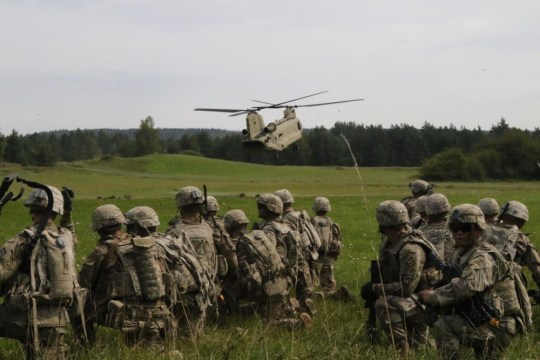
Yellow Ribbon America News Desk:
By .S. Army Staff Sgt. Ange Desinor
3rd Armored Brigade Combat Team, 4th Infantry Division
GRAFENWOEHR TRAINING AREA, Germany, Aug. 28, 2017 — Soldiers of the 3rd Armored Brigade Combat Team, 4th Infantry Division, closed out their final major exercise in Europe with a bang during the Combined Resolve IX live-fire exercise held here Aug. 19-24.
The exercise, involving about 2,000 soldiers from five of the “Iron Brigade’s” seven battalions and the 10th Combat Aviation Brigade, enhanced the readiness of U.S. Army Europe’s regionally allocated land and aviation forces to deter aggression in Europe while serving in support of Operation Atlantic Resolve.
“Combined Resolve IX is a brigade-level combined arms live-fire coordination exercise,” said Army Maj. Michael Harrison, 3rd ABCT, 4th Infantry Division, operations officer. “It’s a culminating event for our readiness progression as well as the deployment. This strengthens our readiness and ability to fight as a brigade.”
Synchronzied Capabilities
The brigade synchronized capabilities in a defensive scenario that emphasized speed while maneuvering to dominant battle positions against a conventional adversary.
Tanks and mechanized infantry took up the frontline fight as artillery, combat engineers, close-air support and unmanned aerial reconnaissance shaped conditions before and during the fight.
“This was a chance for us to challenge ourselves and see how we operate, how we fight, and how we function as a brigade-level organization,” Harrison said.
Combined Resolve IX was the sixth brigade-level combined arms live-fire coordination exercise for 3rd ABCT in the last 13 months.
Four of those exercises occurred during the brigade’s nine-month Atlantic Resolve rotation, including two opportunities to serve as a multinational task force during U.S. Army Europe exercises Combined Resolve VIII at Hohenfels Training Area, Germany, and Getica Saber at Cincu, Romania.
“We are very well trained,” Harrison said. “When we go back to Fort Carson, Colorado, our level of readiness will be extremely high, especially when we transition back to our own training area.”
Army Sgt. Maj. Joseph Nicholson, the operations sergeant major for 3rd ABCT, 4th Infantry Division, said a key for the brigade is carrying forward the knowledge gained during the latest exercise and the cumulative bilateral and multinational training that’s occurred with NATO allies and partners since the brigade arrived in Europe in January.
“Our goal moving forward is to maintain our current state of readiness. We need to ensure that everything we have learned here is not lost. It must be captured and continued to be exercised and improved upon,” Nicholson said.
Air Assault Training
During Combined Resolve IX, an emphasis by the brigade was imposing its lethality on an opponent early and often. This included an air assault to move scouts and infantrymen to forward positions and an artillery raid designed to steer the notional enemy onto ground favorable to the Iron Brigade.
“The artillery raid was an interesting thing to do because some soldiers have never done it for and actual mission. Throughout this entire Atlantic Resolve rotation, we have really emphasized agility and innovative approaches to engaging a near-peer threat, if we ever needed to,” Harrison said.
This final validation exercise also allowed USAREUR’s rotational armored brigade to team up with its rotational helicopter assets from the 10th CAB, out of Fort Drum, New York. During the main fight, AH-64 Apache attack helicopters addressed targets overhead as M1A2 tanks from 1st Battalion, 68th Armor Regiment, pushed to encounter their own targets.
Additionally, infantrymen from 1st Battalion, 8th Infantry Regiment, who normally serve in a mechanized role in Bradley Fighting Vehicles, were excited to jump in UH-60 Black Hawk and a CH-47 Chinook helicopter during an air assault with the 3rd General Support Aviation Battalion, 10th CAB.
“It’s not often that we get to do an air assault mission,” said Army 1st Lt. Brandon Castinado, a platoon leader with Company A, 1st Bn., 8th Infantry Regiment “It’s a great experience to see the brigade use all of our assets in various ways to defeat an enemy. This shows that we are capable of completing missions that are thought to be difficult or impossible to achieve. We did it, and we beat the odds. We are adaptable, resilient and most importantly, well-trained.”
Picture: Infantrymen with Company A, 1st Battalion, 8th Infantry Regiment, 3rd Armored Brigade Combat Team, 4th Infantry Division, conduct an air assault with the 3rd General Support Aviation Battalion, 10th Combat Aviation Brigade during U.S. Army Europe’s Combined Resolve IX exercise at the 7th Army Training Command’s Grafenwoehr Training Area, Germany, Aug. 24, 2017. U.S. Army photo by Staff Sgt. Ange Desinor
President Trump Unveils New Afghanistan, South Asia Strategy
August 22, 2017
Yellow Ribbon America Breaking News!
By Jim Garamone
DoD News, Defense Media Activity
WASHINGTON, Aug. 21, 2017 — President Donald J. Trump unveiled an expansive new strategy for South Asia aimed at bolstering American security.
The new strategy encompasses Afghanistan, Pakistan, India, the Central Asian nations and extends into Southeast Asia. He stressed the strategy will not have artificial timelines built into it.
Trump spoke before a crowd of hundreds of service members at Conmy Hall at Joint Base Myer-Henderson Hall in Virginia.
Trump said the American people are frustrated by the nation’s longest war in Afghanistan, calling it a war without victory. The new strategy, he said, is a path toward victory and will step away from a policy of nation building.
The new strategy, Trump said, is a result of a study he ordered immediately after he was inaugurated in January. The strategy is based on three precepts.
“First, our nation must seek an honorable and enduring outcome worthy of the tremendous sacrifices that have been made, especially the sacrifices of lives,” Trump said. “The men and women who serve our nation in combat deserve a plan for victory. They deserve the tools they need and the trust they have earned to fight and to win.”
No Hasty Exit
Trump said the second precept is that a hasty exit from Afghanistan would simply allow terrorists to flood back into that country and begin planning attacks on America and its allies and partners.
The third precept, he said, concerns the threats emanating from the region, which are immense and must be confronted.
“Today, 20 U.S-designated foreign terrorist organizations are active in Afghanistan and Pakistan, the highest concentration in any region anywhere in the world,” the president said. “For its part, Pakistan often gives safe haven to agents of chaos, violence and terror. The threat is worse because Pakistan and India are two nuclear-armed states whose tense relations threaten to spiral into conflict. And that could happen.”
The United States and its allies and partners are committed to defeating these terrorist groups, Trump said.
“Terrorists who slaughter innocent people will find no glory in this life or the next,” he said. “They are nothing but thugs and criminals and predators and — that’s right — losers.”
Trump added, “Working alongside our allies, we will break their will, dry up their recruitment, keep them from crossing our borders, and, yes, we will defeat them, and we will defeat them handily.”
In Afghanistan and Pakistan, the United States will work to stop the resurgence of safe havens that enable terrorists to threaten America, Trump said.
“And we must prevent nuclear weapons and materials from coming into the hands of terrorists and being used against us, or anywhere in the world, for that matter,” he said.
Conditions-Based Strategy
Trump emphasized the strategy will be conditions based and not set to a timetable. “I’ve said it many times how counterproductive it is for the United States to announce in advance the dates we intend to begin or end military options,” the president said. “We will not talk about numbers of troops or our plans for further military activities. Conditions on the ground, not arbitrary timetables, will guide our strategy from now on. America’s enemies must never know our plans or believe they can wait us out.”
Trump said the new strategy will involve all aspects of American power, employing diplomacy, economic might, intelligence and military power to advance American interests and ensure the safety of the homeland and American allies and partners.
The United States, he added, will continue to support the Afghan government and its military.
“Ultimately, it is up to the people of Afghanistan to take ownership of their future, to govern their society and to achieve an everlasting peace,” Trump said. “We are a partner and a friend, but we will not dictate to the Afghan people how to live or how to govern their own complex society. We are not nation building again. We are killing terrorists.”
Trump said Pakistan is a major concern, and he said Pakistan must stop providing safe havens for terrorists who rest and refit for actions in Afghanistan and elsewhere.
“Pakistan has much to gain from partnering with our effort in Afghanistan,” the president said. “It has much to lose by continuing to harbor criminals and terrorists.”
Pakistan Must Change
Trump noted that Pakistan has worked with the United States in the past, but the nation’s policies must change.
“No partnership can survive a country’s harboring of militants and terrorists who target U.S. service members and officials,” Trump said. “It is time for Pakistan to demonstrate its commitment to civilization, order and to peace.”
Trump said India will be a key component in any strategy in the region, and the president wants to work with India’s leaders to provide more economic assistance and targeted development to the people of Afghanistan.
“We are committed to pursuing our shared objectives for peace and security in South Asia and the broader Indo-Pacific region,” he said.
The president pledged that service members will have the rules of engagement they need to take swift, decisive actions. “I have already lifted restrictions the previous administration placed on our warfighters that prevented the secretary of defense and our commanders in the field from fully and swiftly waging battle against the enemy,” he said. “Micromanagement from Washington, D.C., does not win battles. They’re won in the field, drawing upon the judgment and expertise of wartime commanders, and front-line soldiers, acting in real time with real authority, and with a clear mission to defeat the enemy.”
‘Victory Will Have a Clear Definition’
The president described what he believes victory will look like. “From now on, victory will have a clear definition: Attacking our enemies, obliterating ISIS, crushing al-Qaida, preventing the Taliban from taking over Afghanistan, and stopping mass terror attacks against America before they emerge,” he said.
NATO allies and global partners like Australia will support the new strategy and have already pledged additional troops and funding increases, the president said.
Defense Secretary Jim Mattis said he has directed Marine Corps Gen. Joe Dunford, the chairman of the Joint Chiefs of Staff, to prepare to carry out the president’s strategy. “I will be in consultation with the secretary general of NATO and our allies — several of which have also committed to increasing their troop numbers,” Mattis said in a written statement. “Together, we will assist the Afghan security forces to destroy the terrorist hub.”
The president concluded his speech speaking directly to service members in the hall and around the world.
“With our resolve, we will ensure that your service and that of your families will bring about the defeat of our enemies and the arrival of peace,” Trump said. “We will push onward to victory with power in our hearts, courage in our souls and everlasting pride in each and every one of you.”
Official White House Photo by Shealah Craighead
Welcome Home USS Santa Fe…!
August 16, 2017
Yellow Ribbon America News Desk:
A U.S. Sailor receives an embrace from his sweetheart at Joint Base Pearl Harbor-Hickam, Hawaii, Aug. 15, 2017, upon returning from a deployment aboard the attack submarine USS Santa Fe. U.S. Navy photo by Petty Officer 1st Class Daniel Hinton
South Dakota Airmen Team Up With South Korean, Japanese Counterparts
August 9, 2017 DoD News, Defense Media Activity
JOINT BASE PEARL HARBOR-HICKAM, Hawaii, Aug. 9, 2017 — Two U.S. Air Force B-1B Lancer bombers under the command of Pacific Air Forces joined their counterparts from the South Korean and Japanese air forces Aug. 7 in sequenced bilateral missions.
This serves as the first mission for the crews and aircraft recently deployed from Ellsworth Air Force Base, South Dakota, in support of U.S. Pacific Command‘s continuous bomber presence missions, officials said.
After taking off from Andersen Air Force Base, Guam, the B-1s — assigned to the 37th Expeditionary Bomb Squadron — flew to Japanese airspace, where they were joined by Japanese F-2 fighter jets. The B-1s then flew over the Korean Peninsula, where they were joined by South Korean KF-16 fighters. The B-1s then performed a pass over the Pilsung Range before leaving South Korean airspace and returning to Guam.
Enhancing Combined Capabilities, Skills
Throughout the mission, which lasted about 10 hours, the aircrews practiced intercept and formation training, Pacific Air Forces officials said, enabling them to enhance their combined capabilities and tactical skills while also strengthening the long-standing military-to-military relationships in the Indo-Asia-Pacific region.
Ellsworth B-1s were last deployed to Guam in August 2016, when they took over continuous-bomber-presence operations from the B-52 Stratofortress bomber squadrons from Minot Air Force Base, North Dakota, and Barksdale Air Force Base, Louisiana.
“How we train is how we fight, and the more we interface with our allies, the better prepared we are to fight tonight,” a 37th EBS B-1 pilot said. “The B-1 is a long-range bomber that is well-suited for the maritime domain and can meet the unique challenges of the Pacific.” The pilot is not identified by name for security considerations.
Commitment to Stability, Security
Aircrews, maintenance and support personnel will continue generating B-1 bomber sorties to demonstrate the continuing U.S. commitment to stability and security in the region, providing commanders with a strategic power-projection platform and fulfilling the need for aircraft that are mission-ready at any time, an important part of national defense during a time of high regional tension, Pacific Air Forces officials said.
“While at home station, my crews are constantly refining their tactics and techniques so that we can better integrate with our counterparts from other nations,” said Air Force Lt. Col. Daniel Diehl, 37th EBS commander. “As demonstrated today, our air forces stand combat-ready to deliver air power when called upon.”
The United States has maintained a regular bomber presence in the Indo-Asia-Pacific region since 2004. The Aug. 7 mission demonstrated the U.S. commitment to regional allies, increased readiness and exercised the right under international law “to fly legally in the place and time of our choosing,” officials said.
Photo: Two U.S. Air Force B-1B Lancer bombers assigned to the 37th Expeditionary Bomb Squadron, deployed from Ellsworth Air Force Base, South Dakota, prepare to take off from Andersen Air Force Base, Guam, for a 10-hour mission, flying in the vicinity of Kyushu, Japan, the East China Sea, and the Korean Peninsula, Aug. 7, 2017. U.S. Air Force photo by Tech. Sgt. Richard P. Ebensberger
Happy Birthday to America’s Coast Guard!
August 4, 2017
On Aug. 4, 1790, the U.S. Coast Guard was created.
Semper Paratus “Always Ready” !
Military.com
The Coast Guard celebrates its 227th birthday in August this year. The Coast Guard is one of America’s five armed forces and traces its founding to Aug. 4, 1790, when the first Congress authorized the construction of 10 vessels to enforce tariff and trade laws, prevent smuggling, and protect the collection of federal revenue. Responsibilities added over the years included humanitarian duties such as aiding mariners in distress.
The service received its present name in 1915 when the Revenue Cutter Service merged with the U.S. Life-Saving Service to form a single maritime service dedicated to the safety of life at sea and enforcing the nation’s maritime laws.
The Coast Guard is a multi-mission, maritime, military service and the smallest of the five Armed Services. Its mission is to protect the public, the environment and U.S. economic interests in the nation’s waterways, along the coast, on international waters, or in any maritime region as required to support national security.

















 Yellow Ribbon America