NASA Selects Air Force Pilot as Astronaut Candidate

June 8, 2017

170606-O-ZZ999-020

Yellow Ribbon America News Desk:

By 412th Test Wing

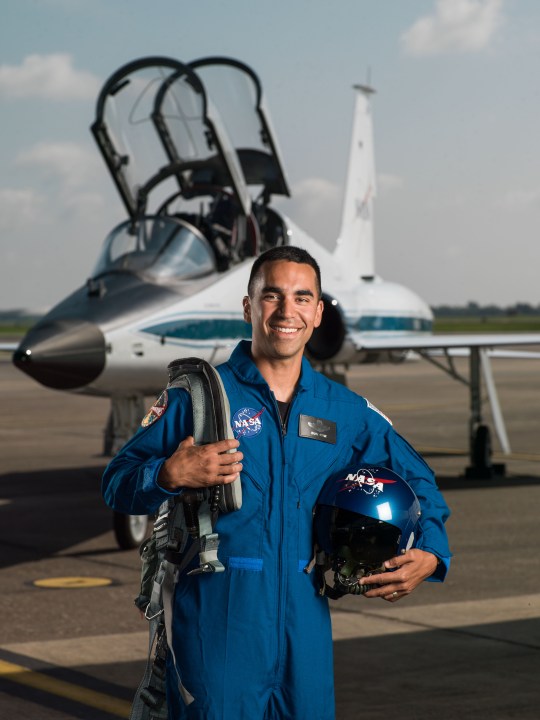
EDWARDS AIR FORCE BASE, Calif., June 8, 2017 — NASA has selected the commander of the 461st Flight Test Squadron here to join the 2017 astronaut candidate class.

Air Force Lt. Col. Raja Chari, who has been selected for promotion to colonel, relinquishes command of the squadron tomorrow. He has overseen developmental testing of the F-35 Lightning II joint strike fighter for the past couple of years while simultaneously serving as director of the F-35 Integrated Test Force.

Chari has flown more than 2,000 flight hours in the F-35 Lightning II, F-15E Strike Eagle, F-16 Fighting Falcon, and F-18 Hornet, including F-15E combat missions in Operation Iraqi Freedom and deployments in support of the Korean Peninsula.

The Iowa native graduated from the U.S. Air Force Academy in 1999 with bachelor’s degrees in astronautical engineering and engineering science. He earned a master’s degree in aeronautics and astronautics from Massachusetts Institute of Technology and graduated from the U.S. Naval Test Pilot School.

One of 12 Chosen

Chari is one of 12 new astronauts introduced yesterday who will train for missions into Earth’s orbit and into deep space. The seven men and five women comprise the 22nd class of American spaceflight trainees since 1959. The group is the largest selected in almost two decades, NASA officials said.

The 12 new candidates include six military officers, three scientists, two medical doctors, a lead engineer at SpaceX and a NASA research pilot.

Chari will report in August to begin two years of training as an astronaut candidate. Upon completion, he will be assigned technical duties in the Astronaut Office while he awaits a flight assignment.

Picture: U.S. Air Force Lt. Col. Raja Chari stands in front of an NASA T-38 Talon supersonic trainer aircraft at Ellington Field in Houston, Texas, June 6, 2017. Chari has been selected to join the 2017 NASA Astronaut Candidate Class. NASA photo by Robert Markowitz

No Time for Nerves: D-Day Through the Eyes of a Combat Medic

June 6, 2017

170606-O-ZZ999-001

Yellow Ribbon America News Desk

By Military Health System Communications Staff

WASHINGTON, June 6, 2017 — They trained with the infantry, carrying first aid kits instead of weapons. They dodged bullets to tend to wounded soldiers, sometimes with whatever supplies they could find. And even in the midst of thick combat, they remained steadily focused on their mission of saving lives. They were the combat medics of World War II.

No amount of training or planning could have prepared them for the casualties inflicted during the largest amphibious assault in history: D-Day, the Allied invasion of Europe.

“Boy Scouts was the closest thing to medical training I had before that,” said Edwin Pepping, who was a 21-year-old Army private first class at the time. “But you didn’t have a chance to be nervous.”

In preparation for ground combat after Pearl Harbor, the Army hurried to create a ready force. Medical units made up of individuals of both military and civilian background were gathered and trained. Their duties included treating minor injuries, applying splints and tourniquets, and bandaging wounds.

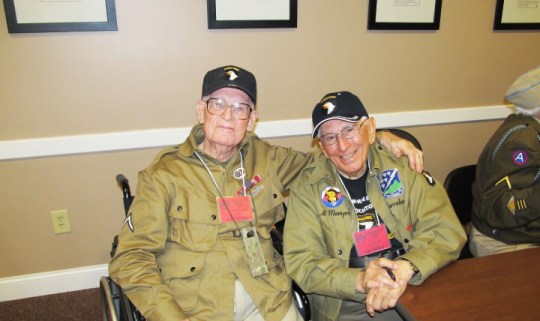
Known as “band-aid bandits” to their comrades, Pepping, who turns 95 in July, and Army Staff Sgt. Albert Mampre were attached to Easy Company, 2nd Battalion, 506th Parachute Infantry Regiment, 101st Airborne Division — the unit later known as the “Band of Brothers.”

Invasion

Seventy-three years ago today, the U.S. took part in the invasion of Normandy, which would ultimately be the turning point of the war in Europe. More than 13,000 aircraft and 5,000 ships were used in the D-Day landing, which was part of Operation Overlord. In the early morning hours of June 6, 1944, Pepping boarded a C-47 Skytrain transport for the big jump. But as often happens in combat, the plan didn’t go as expected.

“We were supposed to be dropped at 700 feet at 95 miles per hour, which was enough to get our parachute to open and get our equipment down safely, but they dropped us at 300 feet at 165 miles per hour, which is almost impossible to survive,” he said.

As Pepping jumped, he was hit by a gust of air that ripped 125 pounds worth of supplies off of him. His parachute opened at the same time, causing him to spin violently before falling to the ground. He hit the ground so hard that his own strapped helmet flew back and knocked him in the neck, leading to a concussion and three cracked vertebrae.

After landing near the town of Angoville-au-Plain behind Utah Beach, Pepping spent the next several hours helping another medic, Willard Moore, bring severely wounded soldiers to a makeshift aid station in a nearby church. Moore drove the jeep while Pepping loaded the wounded and nursed them until they got back to the church, he said.

Saving Lives

“There were so many catastrophic wounds that a lot of the time it was beyond us to do anything except to see if we could get a doctor to help,” Pepping said. Two other medics treated patients at the aid station. They used whatever medical supplies they could find after losing most of theirs in the jump, and they treated whomever they found — American, French and German alike. Together, they saved more than 80 lives that day.

“When we flew into Normandy, we met some very, very serious cases, and a lot of the time we didn’t know exactly how to handle them,” Pepping said, adding that it taught him perseverance. Today, the church serves as a memorial. The blood stains where the wounded were laid remain on the pews.

“A sense of humor is really what saved us,” he said, noting that the biggest lesson he learned as a medic was to duck. “You couldn’t make it through the war without it,” he added. Medics were unarmed, and they were identified by the Red Cross symbol on their helmets and arm bands. Even so, they weren’t always spared as a target.

Mampre, who had to miss the jump on D-Day after coming down with a severe infection just a few days before, went on to receive the Purple Heart for action in Holland. After spotting a wounded lieutenant in a field, he was told the soldier was dead and best left alone. Mampre ran out to him through heavy gunfire and found him alive. He was shot through the leg, but he and the lieutenant made it to safety and survived.

“I’d do it all over again,” Mampre said about being a combat medic. “But if they need me again at 95 years old, boy, we’re in trouble.”

Picture: Edwin “Doc” Pepping, left, and Albert “Al” Mampre served as combat medics attached to Easy Company, 2nd Battalion of the 506th Parachute Infantry Regiment, 101st Airborne Division, also known as the “Band of Brothers.” Photo courtesy of Matthew Pepping

Memorial Day – May 29, 2017

May 30, 2017
170529-A-ZZ998-002L
Yellow Ribbon America Breaking News!
President Donald J. Trump and Vice President Mike Pence talk with Christian, 6, and his mother Brittany Jacobs at the grave of Christian’s father in Section 60 of Arlington National Cemetery on Memorial Day, May 29, 2017, in Arlington, Va. U.S. Army photo by Elizabeth Fraser

Honors Parade

May 22, 2017
170522-D-GO396-0227
Yellow Ribbon America Breaking News!
U.S. Defense Secretary Jim Mattis hosts a full honors parade prior to the North American Defense Ministerial at the Pentagon, May 22, 2017. From left to right are Mexican Navy Secretary Adm. Vidal Soberon, Mexican National Defense Secretary Gen. Cienfuegos Zepedas and Canadian Defense Minister Harjit Sajjan. DoD photo by U.S. Air Force Tech. Sgt. Brigitte N. Brantley

President Trump Salutes Coast Guard Mission in Academy Commencement Address

May 18, 2017

170517-G-ZX620-090

Yellow Ribbon America Breaking News!

By Shannon Collins

DoD News, Defense Media Activity

WASHINGTON, May 17, 2017 — President Donald J. Trump expressed pride in the Coast Guard’s mission today in his address at the U.S. Coast Guard Academy‘s 136th commencement in New London, Connecticut.

Each year, the president delivers the commencement address at one of the U.S. military service academies, and this was Trump’s first address to a service academy graduating class as commander in chief.

“The Coast Guard stands watch at our ports, patrols our waterways and protects our infrastructure,” he said. “The Coast Guard is deployed in support of operations in theaters of conflict all around the world, but not only do they defend American security, they also protect American prosperity. They help keep our waters open for Americans to do business. It keeps our rivers flowing with commerce, and it keeps our ports churning with American exports.

“You help billions and billions in goods to navigate our country every day,” the president continued. “You’re the only federal presence upon our inland waterways. You pursue the terrorists, stop the drug smugglers and keep out all who would do harm to our country. Together we have the same mission, and your devotion and dedication makes me proud to be your commander in chief.”

Praise for Public Service Work

The president recognized the 195 cadets commissioned as Coast Guard officers today for their public service work, including serving breakfast at a local food bank, rebuilding a home with Habitat for Humanity and donating 24,000 hours in community service.

“You’ve done amazing work, and in true Coast Guard fashion, you had fewer people and fewer resources, but you accomplished the objectives,” Trump said. “You did it with skill, with pride, under budget and ahead of schedule.”

As millions of high school and college graduates have their own commencement ceremonies, the president said, they may ask themselves, “What now?” But the cadets won’t have that issue, he added.

“Years from now, when they look back, they may ask themselves, ‘Did I make the right choice?’ In the Coast Guard, you may face many challenges, but that question isn’t one of them,” Trump said. “You’ll know how you spent your time, saving lives and serving your country. You were a leader in the United States Coast Guard.”

Cadets at the academy pursue a four-year program for a bachelor’s degree in science. They pay no tuition and are required to serve in the Coast Guard for five years following graduation.

Leaders of Character

In his remarks to the graduating class, Coast Guard Commandant Adm. Paul F. Zukunft advised the new officers to be leaders of character.

“We run the business of military service as national security, and with national security comes public trust,” he said. “These are interwoven, and you have neither without leaders of character. Today, the United States Coast Guard operates in the waters of over 60 nations throughout the world, using up to deadly force to enforce fishery regulations [and] to go after drug smugglers. We had over 27 metric tons of cocaine in the holds of Coast Guard cuttters that we seized in the last three weeks alone. We have leveled the playing field because we have leaders of character carrying out those missions.”

Zukunft said the Class of 2017’s motto, “Storms Yield Courage,” meant something different 40 years ago when he was at the academy.

“There was only one storm on the horizon, and that was the Cold War,” he told the class. “It was a war with high stakes, but it was a predictable war. You’re going to be leaders in a world that has storms on many fronts. It’s going to require leaders with character to lead this great nation. A leader is not what you wear on your shoulders. A leader is what you hold in your heart.”

Secretary of Homeland Security John F. Kelly, who served 45 years with the Marine Corps from private to four-star general, said his advice to the young officers was simple.

“Take care of your people. Train them, mentor them and defend them,” he said. “They will do anything you ask them to do. They’ll show up to work on time. They’ll put their lives at risk on the high seas interdicting drugs, dealing with the most dangerous men on the planet, or they’ll jump out of a helicopter in the middle of the night in the raging seas to save somebody. All you have to do is lead them.”

Picture: President Donald J. Trump salutes the 195 cadets during the 136th U.S. Coast Guard Academy Commencement in New London, Conn., May 17, 2017. Each year, the president delivers the commencement address at one of the U.S. military service academies. This was the first time Trump addressed a service academy graduating class as commander in chief. Coast Guard photo by Petty Officer 2nd Class Patrick Kelley

Pacific Insertion

May 18, 2017

170516-A-EL056-010A

Yellow Ribbon America Breaking News!

A Soldier jumps from a Marine Corps UH-1Y Huey helicopter into the Pacific Ocean, May 16, 2017, during helocast insertion training. U.S. Army photo by Staff Sgt. Armando R. Limon

Mock Assault

May 18, 2017
170511-F-BH566-042

 Yellow Ribbon America Breaking News!

U.S. Air Force Special Tactics Airmen, Italian Special Operations Forces and members of the Jordanian Armed Forces Special Task Force conduct a simulated assault on a compound during exercise Eager Lion 17 at King Abdullah II Special Operations Training Center in Amman, Jordan, May 11, 2017. U,S, Air Force photo by Senior Airman Ryan Conroy

Dual-Military Couple Tackles Challenges

May 16, 2017

Month of the Military Child, Leidholm Family

Yellow Ribbon America Breaking News!

Face of America’s Defense:

60th Air Mobility Wing

TRAVIS AIR FORCE BASE, Calif., May 16, 2017 — The Leidholms are just like any ordinary young family. They get up early to deal with the happy chaos of getting themselves ready for work and preparing their two small daughters for the day.

Dad and Mom tag-team — he changes the baby’s diaper and ensures their 3-and-a-half-year-old daughter is dressed and clean, then feeds the cats and dogs. He heads out the door by 6:30 a.m.

Mom spends a few more moments nursing their 8-month-old daughter, then leaves to drop the kids off at day care and get to the office. Nights and weekends are spent doing the usual stuff: housework, homework, laundry, running errands, watching television and, of course, sharing time with each other.

They are a typical American family, except for one significant difference: Staff Sgts. Kyle Leidholm of the 60th Maintenance Squadron and Nicole Leidholm of 60th Air Mobility Wing Public Affairs both serve their country in the Air Force here.

Dual-Military Couple Challenges

The Leidholms work a fairly normal duty day, but unlike most families, they know their normal routine could be dramatically interrupted at any time. Kyle is an aero repair technician, servicing heavy-lift transport aircraft. Nicole is a photojournalist and the noncommissioned officer in charge of media relations. They are aware that one or both of them could be deployed overseas with little notice. Like all military personnel, they are ready to put the needs of their country above all else.

Dual-military marriages — a service member married to another service member — are becoming more common, with the highest percentage of these couples being in the Air Force, according to a 2008 Defense Department study on military families.

Both Kyle and Nicole joined the military when their college plans didn’t work out. Nicole was still in technical school when the two married. Kyle was stationed here, and Nicole joined him soon after. The girls were quickly added to the growing family.

The military treats each member of a dual-military couple as an independent entity, despite the fact that the couple makes decisions jointly. Unfortunately, this can be problematic at times.

“Work is definitely a lot harder now than it was before kids,” Kyle said. “Working extended shifts and nights is harder. The balance of family and job tend to blur.”

“It’s hard trying to explain to my oldest why Dad hasn’t come home from work yet, or why Dad is going to work at night,” Nicole said.

“She’s very curious and notices everything,” she added. “When he was on 12-hour days, I was the one coming home after work and cooking dinner and getting her ready for bed on top of when I was pregnant. It’s definitely an added challenge to balance life and work duties.”

Child Care Costs

Often, there can be difficulty fitting child care expenses within a family budget.

“The cost of child care is not cheap,” Nicole said. “We use family child care, so our costs are a bit more than at the child development center on base, but I like it. There are usually a smaller number of children, and they take care of my girls like their own.”

“On top of those costs, infant care is even more,” she continued. “So having two kids in child care was almost like sticker shock when I first went back to work after maternity leave. Fortunately, we both received promotions around that same time so our ‘extra money’ goes toward the cost of child care. The child care expenses a little more than doubled for each week with the new baby.”

Since Sept. 11, 2001, deployments are the rule, not the exception, for military families. Research from a 2009 RAND National Defense Research Institute study shows these deployments often have a more negative effect on dual-military couples’ retention and family life than on than on service members who aren’t married to another service member.

Kyle shared an experience he had when his wife was deployed.

“I had appliances die on me during a base exercise and I had to figure out child care by myself without help from my spouse on the other side of the world,” he said. “Just the day-to-day Air Force obligations affected both me and my wife. And sometimes, it carried over to the kids.”

“Our first deployments didn’t really have an impact on our oldest daughter,” Nicole said. “She was too young to remember. The deployments were harder on us. I deployed first in 2014 to Southwest Asia, and it was a lot harder on my husband, because he, all of a sudden, was a single dad.”

Deployments

She added, “I also do all the finances, so I had to keep on him to pay the bills. At the time, he worked in a shop that did eight-hour days, but more often than not, those days became 12-hour days [with] no notice. They also worked a Panama schedule, but because I was deployed, they worked his schedule to be Monday through Friday. Thankfully, we also had a flexible child care provider that could help us out.”

A Panama shift is 24/7 coverage with four teams working two 12-hour shifts on a rotating pattern — two days on, two days off; three days on, three days off; two days on, three days off.

Child care most notably affects the retention rate of dual-military couples. Although the RAND study shows both male and female service members perform at the same levels on the job, females are more likely to leave the military citing family responsibilities. Male service members are more likely to cite financial concerns or career opportunities.

“I’ll play it enlistment by enlistment,” Kyle said. “I would like to retire out of the military, but we will see how the next 14 years go.”

Supportive Leadership

Having supportive leadership and an understanding and flexible work environment is vital to alleviate the stressors of a dual-military family.

It’s the only thing that can make it so I can continue to serve and still be there for my kids and wife,’ Kyle said.

“It’s extremely important,” Nicole said. “Recently, when I was on a trip, I was supposed to be back after four days and ended up being away for seven. My leadership asked to make sure Kyle was OK and if he needed anything. It’s good to know if there was anything needed, they were there for us. It’s hard to focus on the mission if my family isn’t cared for when I’m away.’

Today’s technology makes it easier to keep in touch while being deployed for any length of time and lessens the anxiety of separation. Nicole’s first deployment was for six months.

“We were only three years into our marriage — young by any standard. So it definitely put a strain on our marriage,” she said. “Skype was a big one when I was deployed, but now — and even when I was [on a temporary duty assignment] — we used Facebook Messenger to video chat. We also used a free texting app when I was deployed. I’ve now learned that my phone carrier has an overseas plan that I would look into using the next time either of us is deployed. We also sent a lot of care packages.”

Family Care Plan

Having a family care plan is a mandatory military requirement to protect children of military families when military parents must answer the call to duty.

“Dual and single military families can face some unique challenges,” said Air Force Master Sgt. Hugh Fetla, the 60th Comptroller Squadron’s first sergeant.

Fetla served as first sergeant to both of the Leidholms, who are in different squadrons.

“Deployments and unaccompanied assignments can make child care and maintaining the marriage very difficult,” Fetla said. “Mission permitting, the member’s leadership can work with the dual and single military families when assigning deployment cycles and work schedules. But sometimes, the mission does not allow leadership to be 100-percent accommodating. When this happens, one of the most important items the dual and single military families need to have is a family care plan. This will ensure the children are taken care of during a medical emergency or period of separation.”

“I think Kyle has had to use it. I’ve almost had to,” Nicole said. “Every year, his unit recertifies the FCP. We also have to keep it updated, such as when our provider moved — we changed providers — and when we had our second daughter.”

With time in service, promotions and the gained experience of military life, there is an increased understanding and acceptance.

Seeing the Big Picture

“I can see the bigger picture of what the mission needs,” Kyle said. “It makes it easier to get on board with the decisions leadership makes. I wish it had been relayed to me differently when I was a younger airman with kids.”

Nicole agreed.

“We have a lot more responsibilities now as noncommissioned officers than as airmen,” she said. “Now, we are taking care of people at work and at home. I guess in a way, for me, becoming a mom first helped prepare me to be a leader.”

Though the demands of dual military couples can be stressing, Kyle and Nicole’s unwavering commitment to each other and to their children make it possible to readily face any challenge.

“Having us both in [the Air Force] is cool, because we understand the job that each of us does. Sometimes, spouses don’t know what their significant other does every day at work,” Nicole said. “It also made the deployments easier in my mind, because we knew the locations and our resources.

“It’s also cool because we can talk military jargon with each other and have an understanding of some of the stressors that may be going on,” she continued. “At the supervisory level, we can bounce ideas off each other and learn together. It’s also neat to almost get an inside seat to see how another squadron operates.”

Kyle said Nicole makes him think bigger than maintenance when he talks with her about his airmen and how to help them. “She always has that important phone number when I don’t know who to call,” he added.

Nicole is proud of her daughters, especially her eldest, who at only 3 years of age has seen one or the other parent go through two six-month deployments and three temporary duty assignments.

“It’s amazing how resilient kids are,” she said.

Picture: U.S. Air Force Staff Sgts. Kyle Leidholm of the 60th Aircraft Maintenance Squadron and Nicole Leidholm of 60th Air Mobility Wing Public Affairs pose for a family portrait at Travis Air Force Base, California. In addition to the challenges they face as individual service members, the couple must also contend with issues unique to dual-military couples. Air Force photo by Heide Couch
President, First Lady Welcome Military Moms to White House

May 12, 2017

Melania-Trump-Just-MELTED-Our-Hearts-By-Doing-This-At-White-House-Easter-Egg-Roll

Yellow Ribbon America Breaking News!

WASHINGTON, May 12, 2017 — In honor of Mother’s Day, President Donald J. Trump and First Lady Melania Trump welcomed active-duty troops, their spouses and mothers to the White House, today.

“As Commander in Chief of the United States, my supreme duty is to protect our citizens and that means supporting our servicemen and women,” the president said. “That obligation begins the first day they put on the uniform and continues every day after, when they return to civilian life as Veterans.”

Trump said he would make sure the nation always takes care of its Soldiers, Sailors, Airmen, Marines and the members of the Coast Guard.

“To every military service member, mother and spouse here today, I want you to know you have my complete and total support … [and] the White House, this administration and this government stands fully behind you,” the president said.

Moms Are Heroes, Too

“As we celebrate Mother’s Day this weekend, this is one of many opportunities for us to thank the incredible military mothers who love and care for our nation’s heroes,” Trump said.

“The mothers are heroes, too. It is your sacrifice that protects our nation, safeguards our liberties and makes sure our beautiful American flag always waves proudly above our very glorious land,” he said to the military mothers in the audience.

The President introduced First Lady Melania Trump, who said she was honored by the military members’ presence as the nation celebrates National Military Appreciation Month and Mother’s Day.

Title That Claims The Heart

“As everyone in this room knows, mother is a title that claims your heart and changes your life forever,” the first lady said. “In fact, it has been said that having a child means allowing your heart to walk around outside of your body. For the mothers of someone who has, or is, serving our country, this must be especially true.”

Noting that while she, too, is a mother, Melania Trump said she does not know of the many different challenges that come with being the parent of a service member.

Part Of A Community

“While you stand with many other parents, so strong and so proud, I am sure that you sometimes march on this journey alone,” the first lady said, adding, “While your sons and daughters are away serving so selflessly, having a community share even some of that burden must make all the difference in the world.”

Melania Trump told the mothers in the audience they are part of a community, and the White House is proud to be a part of it with them.

“Thank you for all that you do, for your selflessness and for your own sacrifice on behalf of our country,” she said.

“Let today’s celebration with this community of strong and selfless moms be a first step in building relationships,” the first lady said, “and in your knowing, that my husband and I, along with … everyone here at the White House, hold you close in our hearts and thoughts each and every day.”

Sailor’s Goodbye

May 11, 2017

170508-N-MZ078-391Y

Yellow Ribbon America Breaking News!

U.S. Navy Petty Officer 2nd Class Dylan Bagdasarian says goodbye to his wife and daughter in San Diego, May 8, 2017, before setting off on a scheduled deployment to the U.S. 7th Fleet and U.S.

5th Fleet areas of responsibility aboard the USS Lake Erie. U.S. Navy photo by Seaman Lucas T. Hans