Face of Defense: U.S. Marine Helps Families of Fallen Service Members

March 3, 2017

Sgt. Alicia Hojara Superhero Unmasked

By U.S. Marine Corps Lance Cpl. Cody Lemons

Marine Corps Air Station Cherry Point

U.S. MARINE CORPS AIR STATION CHERRY POINT, N.C., March 3, 2017 — Superheroes come in all sizes and all kinds of disguises — Marine Corps Sgt. Alicia Hojara is living proof of that.

In mid-December, the diminutive Marine was surrounded by a theater full of children and their families, their expressions changing from anticipation to hope to laughter in the flickering glow of the big screen. The movie, a new animated feature with comical animal characters and lots of hopeful vocals, seemed to be just what some of these families need at the moment: an escape from real-world worries to a place where they could just relax.

Hojara had left her uniform home, replaced by a different kind of camouflage — casual clothes, hair at ease, and a gentle expression that put her young charges at ease when they need it the most.

Most other days, you can find Hojara at the front of a classroom of young Marines as they navigate their way through the intricate details of aviation ordnance handling at the Center for Naval Aviation Technical Training Unit here. There’s no kid’s play here; this is serious work that will prepare the next batch of aviation ordnance Marines to load teeth onto the modern-day dragons that squat across Marine Corps flight lines around the world.

But, from time to time, Hojara slips away like Clark Kent to take on another heroic mission, volunteering her time to help families who have lost an active-duty loved one. Hojara routinely makes time to volunteer for different organizations, such as local humane societies for the protection of animals; Snowball Express, which provides support to families of deceased service members; and her favorite, the Tragedy Assistance Program for Survivors, otherwise known as TAPS.

As Hojara sat in the shadowy theater on a mission with Snowball Express, draped in her invisible cape of good will, she feels the kind of satisfaction that superheroes must experience every time they swoop down and pull a victim a little further from despair. Chalk up one more for the good guys.

Maintaining Military Ties

“I work at the Good Grief Camps and seminars for children,” Hojara said. “It’s the child’s connection to the military, because a lot of times when they lose that family member who’s in the military, they get separated from the military lifestyle. They don’t live on base anymore, and a lot of them go back home, so it’s just kind of that connection to the military for those kids. We are mentors for the weekend, and we take them on campouts and do different things in different cities.”

“The rewarding feeling I get from giving back to these families, seeing that child’s face light up and seeing the bond that’s created between the military mentor and that child is completely worth it to me,” she said. “The connections we make last more than a weekend. … Some mentors stay in that child’s life. We go to graduations, important events like a recital or sporting event, help them pick out colleges. We become a part of their support network and are welcomed as family.”

“If something were to happen to me, I would want those resources for my family,” Hojara added. “These families don’t have that connection anymore, and we are that resource for them.”

Volunteer Award

Her attitude and dedication earned Hojara the Carteret County Chamber of Commerce’s Service Person of the Quarter award, which is given to a service member who has given up personal time to give something back to the community. At the Feb. 10 award luncheon in Emerald Isle, North Carolina, she stressed that others should get out and volunteer.

“Find something that you love. People are always looking for volunteers in the local community,” she said. “It doesn’t matter how you volunteer. It doesn’t have to be with kids, and it doesn’t have to be with pets. If you enjoy getting to know older people’s stories, go to a nursing home and spend time with them.”

But in that almost-magical theater, Hojara wasn’t thinking about awards and speeches to come. She just focused on shining eyes and the big smiles on the faces of those truly thankful for her superhero-like gesture. Later, she would don her familiar green and khaki uniform, adjust her laser-like focus to her “daytime” mission, and mentor young Marines on the challenges that lie ahead. Unlike some superheroes, this Marine shows her strength whether she is wearing her cape or not.


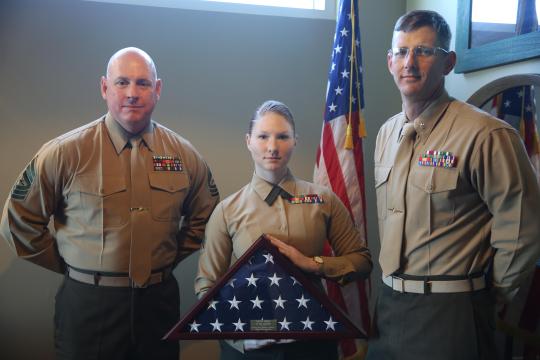
U.S. Marine Corps Sgt. Alicia Hojara, center, an instructor at the Naval Aviation Technical Training Unit at Marine Corps Air Station Cherry Point, N.C., holds the flag she received as the Carteret County Chamber of Commerce’s Service Person of the Quarter, Feb. 10, 2017. Master Sgt. Christopher McGuire, left, and Lt. Col. Garrett Randel, right, nominated Hojara for her dedication to giving back to the local community. Randel is the school’s commander and McGuire is the aviation ordnance chief. Marine Corps photo by Lance Cpl. Cody Lemons

Pentagon Spokesman Discusses ISIS Preliminary Plan, Budget Amendment

February 27, 2017

Flintlock 2017 kicks off in N'Djamena, Chad

By Cheryl Pellerin

DoD News, Defense Media Activity

WASHINGTON, Feb. 27, 2017 — U.S. Defense Secretary Jim Mattis will present a preliminary version of the Pentagon’s new plan to rapidly defeat the Islamic State of Iraq and Syria during a meeting of the White House Principals Committee today, Navy Capt. Jeff Davis said here this morning.

The Cabinet-level senior interagency forum, which usually does not include the president, already has received copies of the classified report, which Davis described as a framework for a broader global plan. President Donald J. Trump requested the plan in a Jan. 28 presidential memorandum.

“This is not just a military plan,” he told reporters during a briefing. “It draws upon all elements of national power — diplomatic, financial, cyber, intelligence [and] public diplomacy, and it’s been drafted in close coordination with our interagency partners.”

Davis added, “This plan is truly transregional. This is not just about Iraq and Syria, it is about defeating ISIS around the globe,” and other transregional violent extremist organizations, such as al-Qaida.

“From the secretary’s standpoint,” Davis said, “he is very committed to rebuilding readiness and is looking for us to find ways to do that quickly and in ways that reflect our being good stewards of taxpayer dollars.”

2017 Budget Amendment

Davis also said the Pentagon is working with the Office of Management and Budget to finalize Defense Department budget amendment numbers.

“We are not able at this point to confirm specific numbers, the captain said, “but stay tuned to what OMB has to say. Once we’ve settled on the numbers we are postured to provide OMB with our budget amendment material as soon as possible in order to meet their goal of March 1.”

As Mattis has emphasized, he added, the budget amendment will focus on meeting warfighter needs and addressing critical readiness shortfalls.

“The highest priority for the fiscal year 2017 budget amendment is on programs and efforts that can be executed in the remainder of [fiscal year 2017] ending on Sept. 30,” Davis said. “Items that cannot be reasonably expected to be executed in this fiscal year will be recommended to be deferred [for placement] in the FY 2018 base budget.”

Exercise Flintlock 2017

Also during the briefing, Davis said that beginning today about 2,000 service members from 24 African, European and North American partner nations will participate in Flintlock 2017 — U.S. Africa Command’s premier special operations forces exercise. It takes place in seven nations throughout North and West Africa.

“This year,” Davis said, “Flintlock is being hosted by Burkina Faso, Chad, Cameroon, Niger, Mauritania, Morocco and Tunisia.”

The exercise bolsters partnerships among African, European and North American special operations forces, increasing their ability to work together in times of crises, Davis added.

According to Africom, participating nations include Algeria, Burkina Faso, Cabo Verde, Cameroon, Chad, Mauritania, Morocco, Niger, Nigeria, Senegal, Tunisia, Australia, Austria, Belgium, Canada, Denmark, France, Germany, Italy, The Netherlands, Norway, Spain, the United Kingdom and the United States.

Chadian soldiers raise the flags of partner nations participating in Flintlock 17 during the opening ceremony Feb. 27, 2017. Flintlock is an annual Special Operations Exercise involving more than 20 nation forces that strengthens security institutions, promotes multilateral sharing of information, and develops interoperability among partner nations in North West Africa.

U.S. Army photo by Staff Sgt. Terrance Payton

Air Force Chief Of Staff Outlines Future Challenges of Military Readiness

February 23, 2017

SD arrives at NATO

By Terri Moon Cronk

DoD News, Defense Media Activity

WASHINGTON, Feb. 23, 2017 — Readiness is central to the military services, and the biggest challenge for the U.S. Air Force lies in its growth as its smallest-ever force takes on growing missions, Air Force Chief of Staff Gen. David L. Goldfein said today.

Speaking at the Center for Strategic and International Studies here, the general said that, at 660,000 active-duty personnel, today’s Air Force is “the smallest we’ve ever been.”

Goldfein said the Air Force has “serious challenges” in terms of its readiness.

“For an air component, there are five things that go into building readiness,” the general said. “You’ve got to have trained people, a weapons system sustainment program [and] a program that pays for the actual flying.”

Once airborne, there must be places to train and the time to train, he added.

People: Top Priority

The general said that for him and Defense Secretary Jim Mattis, people are the No. 1 readiness priority.

“There’s talk of going to a year-long continuing resolution,” Goldfein said of the Defense Department budget. “That’s $1.3 billion. I’m not going to be able to hire the people I need to get those aircraft airborne or get the pilots to fly those missions. I’m not going to be able to get aircraft in a depot; the lines are going to stop. The civilian hiring freeze will continue for the remainder of the year. I’m not going to have the flying hours to get those things airborne, I’m not going to be able to invest in the training and I’m not going to have any relief on the time.”

The demands on the Air Force have been consistent for the last 15 years in four key areas, he said: space; cyber; intelligence, surveillance, and reconnaissance; and nuclear enterprise.

With mandatory budget cuts across the Defense Department, the Air Force, for example, has had to make reductions in its personnel, infrastructure and conventional airpower capacity, the general said.

“You could explain [those cuts] in 2013, but when Russia became active in 2014 and invaded another country, [and] when China got active and started militarizing islands in the South China Sea, when [the Islamic State of Iraq and Syria] came back, the world changed,” Goldfein said, and the path the Air Force was on didn’t make sense anymore.

Readiness For Future Conflict

“So, right now, we’ve got to get balance back. And for me, the No.1 thing we’ve got to get after is people. I’ve got to get the formations built back up … for the many missions we’ve been given,” he said.

Goldfein outlined what he sees when he looks at long-term readiness and future conflict.

“I think future conflict victory will go to that individual who can turn data to decision, command and control his or her forces in a way that you can produce multiple dilemmas from multiple domains and multiple components, at a rate and decision speed that overwhelms the adversary, while denying him the ability to do the same,” he said.

What the Air Force needs for the future is to “get the network piece right, which is how we tied together all the domains and components and weapons systems with apps riding on the network to get to decision speed,” the general said, adding, “That’s a major effort we as an Air Force are focused on as we think toward where we are going in the future.”

Industry plays a vital role in the U.S. military’s future, he noted.

“I’m in continual dialogue with [chief executive officers] of all the majors [corporations] and I describe this as one of the problems I need their help solving,” Goldfein said. “I think industry is going to help solve this one and get it right.”

First African-American Medal of Honor Recipient Protected U.S. Flag at All Costs…

February 9, 2017

160208-d-zz999-0208

Meet Sgt. William Carney: The First African-American Medal of Honor Recipient

By Katie Lange

DoD News, Defense Media Activity

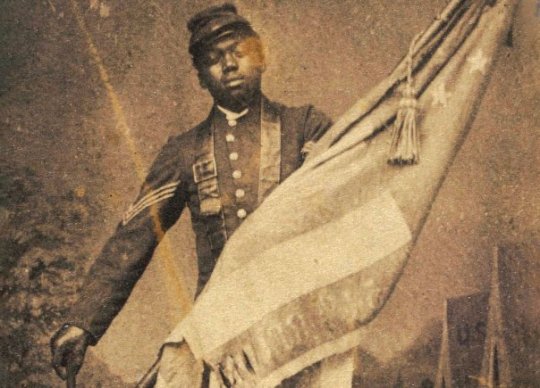
WASHINGTON, Feb. 8, 2017 — Of the 3,498 service members who have received the Medal of Honor throughout U.S. history, only 88 have been black.

In recognition of African American History Month, we’re sharing the stories of the brave men who so gallantly risked and gave their lives for others, even in times when others weren’t willing to do the same in return. We’ll start with the first black recipient of the award: Army Sgt. William H. Carney, who earned the honor for protecting one of the United States’ greatest symbols during the Civil War — the American flag.

Born Into Slavery

Carney was born into slavery in Norfolk, Virginia, in 1840. His family was eventually granted freedom and moved to Massachusetts, where Carney was eager to learn and secretly got involved in academics, despite laws and restrictions that banned blacks from learning to read and write. Carney had wanted to pursue a career in the church, but when the Civil War broke out, he decided the best way he could serve God was by serving in the military to help free the oppressed.

In March 1863, Carney joined the Union Army and was attached to Company C, 54th Massachusetts Colored Infantry Regiment, the first official black unit recruited for the Union in the north. Forty other black men served with him, including two of famed abolitionist Frederick Douglass’ sons. Within a few months, Carney’s training would be put to the ultimate test during the unit’s first major combat mission in Charleston, South Carolina.

Charge on Fort Wagner

On July 18, 1863, the soldiers of Carney’s regiment led the charge on Fort Wagner. During the battle, the unit’s color guard was shot. Carney, who was just a few feet away, saw the dying man stumble, and he scrambled to catch the falling flag.

Despite suffering several serious gunshot wounds himself, Carney kept the symbol of the Union held high as he crawled up the hill to the walls of Fort Wagner, urging his fellow troops to follow him. He planted the flag in the sand at the base of the fort and held it upright until his near-lifeless body was rescued.

Even then, though, he didn’t give it up. Many witnesses said Carney refused to give the flag to his rescuers, holding onto it tighter until, with assistance, he made it to the Union’s temporary barracks.

Promoted for His Actions

Carney lost a lot of blood and nearly lost his life, but not once did he allow the flag to touch the ground!

His heroics inspired other soldiers that day and were crucial to the North securing victory at Fort Wagner. Carney was promoted to the rank of sergeant for his actions. For his bravery, Carney was posthumously awarded the Medal of Honor on May 23, 1900.

Carney’s legacy serves as a shining example of the patriotism that Americans felt at that time, despite the color of their skin. As for the 54th Massachusetts Colored Infantry Regiment in which Carney served? It was disestablished long ago, but reactivated in 2008. It now serves as a National Guard ceremonial unit that renders honorary funerals and state functions. It was even invited to march in President Barack Obama’s inaugural parade.

Read More ‘Medal of Honor Monday’ Posts
http://www.dodlive.mil/index.php/category/moh-monday/

February 6, 2017

SD hosts Canadian minister of defense

U.S. Defense Secretary Mattis, Canadian Defense Minister Meet at Pentagon

DoD News, Defense Media Activity

WASHINGTON, Feb. 6, 2017 — Defense Secretary Jim Mattis hosted Canada’s Minister of National Defense Harjit Sajjan at the Pentagon today, Pentagon spokesman Navy Capt. Jeff Davis said in a statement.

It was Mattis’ first time hosting a defense counterpart as Secretary of Defense, Davis said.

Mattis and Sajjan reaffirmed the U.S.- Canada defense relationship, emphasizing their commitments to the North American Aerospace Defense Command and continental defense, and agreeing to deepen cooperation to protect North America, noting that 2018 will be NORAD’s 60th anniversary, Davis said.

Mattis addressed enhancing North American defense relations and the North American Defense Ministerial, which he offered to host this spring in Washington, D.C.

International Priorities, Operations

The secretary and Sajjan also discussed international priorities and operations, as well as the upcoming NATO Defense Ministerial, Davis said. The secretary and the Canadian Defense Minister discussed U.S. and Canadian leadership as framework nations for enhanced forward presence, members of the international counter-Islamic State of Iraq and the Levant coalition, and support for United Nations peacekeeping, the spokesman said.

Mattis thanked Canada for its commitments to NATO and the counter-ISIL campaign, and agreed to continued discussions with Canada and other coalition members on the progress of the U.S. counter-ISIL strategy review, Davis said.

The secretary and Sajjan also discussed the importance of defense investments and modernization to ensure continued cooperation, the spokesman said.

Mattis commended Sajjan for his consistent leadership, noting the need for both the U.S. and Canada to continue to represent their shared values and advance security, prosperity, and freedom, Davis said.

The two leaders also noted the long relationship between the U.S. Military and Canadian Armed Forces and stated they looked forward to deepening the U.S.- Canada relationship and continuing to work closely together, the spokesman said.

February 2, 2017

Free Tax Software, Support Available for Military, Families

By Lisa Ferdinando

DoD News, Defense Media Activity

WASHINGTON, Feb. 2, 2017 — With the tax season upon us, service members and their families can access free tax-filing software and consultations to help them navigate the task of submitting their annual taxes.

Military members and their families can visit the Military OneSource website or call 1-800-342-9647 for the no-cost “MilTax” software, explained Erika Slaton, a program analyst with Military OneSource.

The Defense Department recognizes military members and their families have unique filing situations with deployments, relocations and various deductions and credits, she said.

The MilTax software, previously known as “Military OneSource Tax Services,” was created with the military situation in mind, Slaton said.

Expert Tax Consultants Ready to Help

Tax consultants are available via phone through Military OneSource, Slaton said. In-person tax filing assistance can be accessed at military installations at a Volunteer Income Tax Assistance location.

The tax consultants can inform eligible users about the unique tax benefits available to service members and their families, Slaton said.

Tax laws change each year, Slaton pointed out, adding MilTax consultants are experts on the nuances of the law and can help users get the tax credits they earned and deserve.

“That’s why it’s such a great program because it is a program that is specifically designed for those unique military tax situations,” she said.

Confidential, Secure Resources

MilTax is confidential and secure, Slaton said. The online filing program allows users to submit a federal return and up to three state tax returns, she said.

Those eligible for MilTax include members of the Air Force, Army, Navy, Marines and National Guard. Coast Guardsmen serving under Title 10 authority are entitled to the services as well. Retired and honorably discharged members are authorized for up to 180 days past their separation. Spouses, dependent children and survivors are able to use the free services as well.

Calculations are backed by a 100-percent accuracy guarantee, Slaton said.

The deadline to file taxes this year is Tuesday, April 18. The traditional tax deadline day is April 15, but it falls on a Saturday this year, and the following Monday, April 17, is Emancipation Day, in the District of Columbia — a legal holiday — according to the IRS.

Call, Click, Connect

Slaton wants the military community to know about the range of services and resources available at no cost through the Defense Department-funded Military OneSource, including related to health, family relationships, education, employment, financial issues, deployments and transitions.

Military members and their families, she said, can “call, click and connect today” to access these services.

“We encourage service members and their families to learn more about Military OneSource, MilTax and all of the services that are available because it is a benefit that they deserve,” she said. http://www.militaryonesource.mil/?source=GovDelivery


October 10, 2016

1014_bschools_columbus_970-630x420

This Monday celebrates Columbus Day, the anniversary of the arrival of Christopher Columbus in the New World on October 12, 1492. Although many today ignore the providential aspects of this momentous event, American Christians can celebrate and remember the heroic actions of Christopher Columbus and his crew.

Columbus is often portrayed as an opportunist and a villain in today’s secular culture, but the “Christ-bearer” (as the explorer’s name, Christopher, means) saw his primary mission to be the spreading of the Gospel. He believed his name was given him, not by accident, but by the will of God. As he wrote in his journal, King Ferdinand and Queen Isabella of Spain, “determined to send me, Christopher Columbus, to…India, to see the…people, and territories, and to learn their disposition and the proper method of converting them to our holy faith….”

Columbus’ journey changed forever the concept which people had of the Earth and opened a new stage of God’s plan for the redemption of the world. Columbus’s zeal planted the Gospel on the shores of the Americas and along with it, the seeds of liberty.

Posted By Foundation for American Christian Education, Tuesday, October 06, 2015

600 More U.S. Troops Deploy back to Iraq.

September 29, 2016

14191897_10154534041950719_6474490065703008211_n

600 More United States Troops to Deploy to Enable Iraqis to Retake Mosul From ISIL

By Terri Moon Cronk DoD News, Defense Media Activity

WASHINGTON, Sept. 28, 2016 — About 600 American troops will be deployed to Iraq to further enable local security forces as they prepare to retake the key Iraqi city of Mosul from the Islamic State of Iraq and the Levant, Defense Secretary Ash Carter said today.

In a statement, the secretary said in anticipation of the Mosul fight, the U.S. and Iraqi governments have agreed that additional U.S. and coalition capabilities could help accelerate the campaign at this critical phase.

Carter said he and Marine Corps Gen. Joe Dunford, chairman of the Joint Chiefs of Staff, recommended deployment of the additional troops to President Barack Obama to further enable Iraqi forces, and that the president authorized it with the support and approval of Iraqi Prime Minister Haider al-Abadi.

Gearing Up for Mosul Offensive

The U.S. troops will work in close coordination with the Iraqi government to provide specific capabilities, such as logistics and maintenance support, and train, advise and assist teams for Iraqi security forces and Kurdish peshmerga for the upcoming Mosul operation. Expanded intelligence resources will be used to disrupt ISIL’s terrorist network in Iraq and beyond, Carter said.

“The coalition to defeat ISIL continues to achieve results on the battlefield, and I congratulate Iraqi security forces on their recent progress, including the operation to free Sharqat,” he said. “The coalition will continue to increase the pressure on ISIL in Mosul and wherever it seeks refuge in Iraq.”

Increasing Pressure on ISIL

The addition of more than 600 additional troops in the coming weeks will bring the force management level to 5,262 U.S. troops as of today, said Navy Capt. Jeff Davis, director of Pentagon press operations.

“We are continuing to increase pressure on ISIL in Mosul in particular and in anticipation of that coming fight … as we close in on Mosul,” Davis said.

While most specific locations cannot be released for security reasons, Davis said, he identified two air bases where the American troops will be sent with specific missions: Al-Asad Air Base in the Euphrates River Valley north of Baghdad, and Qayyarah Air Base near Qayyarah City.

Bringing Capabilities to Air Bases

At Al-Asad Air Base, American troops will provide logistics and maintenance, and help with airfield operations to bring the base to a level that can support a greater pace of operations as the Mosul effort progresses.

Military logisticians will work at Qayyarah Air Base similarly to help the base function as the significant throughput point for the Iraqi forces as they move farther north, he said.

“Mosul is very isolated from the major population centers in Iraq, and to have a throughput point in Qayyarah will allow for greater enabling of our operations there,” Davis said.

The press operations director clarified that the additional train, advise and assist teams and additional intelligence support come under existing authorities. “Nothing is changing in regard to the role of our mission, with the role of what our authorities are to do there,” he noted. “This does not mean any greater role for [U.S.] service members in terms of what their mission is.”

Davis added that the fight remains Iraq’s, and “everything we do there is to support and enable them. They will continue to be the primary trigger-pullers.”

Double-Edged Goal

Two things going on: the retaking of Mosul, and helping to ensure a lasting victory for the Iraqis, Davis said.

“From our perspective, this [force management level] increase has been long anticipated [and] long planned,” he added. “We’ve known there would need to be another additive of capabilities prior to the final push [to Mosul].”

The roughly 600 additional U.S. forces are the number of forces expected to enable Iraq to take on its next major objective of Mosul, Davis said. “There are no major objectives after that,” said he added. “This is it. This is the last big holdout in Iraq for ISIL.”


September 15, 2016

The Task Ahead

On This Day In American History:

September 13, 2016

banner

Francis Scott Key pens Star-Spangled Banner – “America’s National Anthem”

History.com

On this day in 1814, Francis Scott Key pens a poem which is later set to music and in 1931 becomes America’s National Anthem, “The Star-Spangled Banner.” The poem, originally titled “The Defense of Fort McHenry,” was written after Key witnessed the Maryland fort being bombarded by the British during the War of 1812. Key was inspired by the sight of a lone U.S. flag still flying over Fort McHenry at daybreak, as reflected in the now-famous words of the “Star-Spangled Banner”: “And the rocket’s red glare, the bombs bursting in air, Gave proof through the night that our flag was still there.”

Francis Scott Key was born on August 1, 1779, at Terra Rubra, his family’s estate in Frederick County (now Carroll County), Maryland. He became a successful lawyer in Maryland and Washington, D.C., and was later appointed U.S. attorney for the District of Columbia.

On June 18, 1812, America declared war on Great Britain after a series of trade disagreements. In August 1814, British troops invaded Washington, D.C., and burned the White House, Capitol Building and Library of Congress. Their next target was Baltimore.

After one of Key’s friends, Dr. William Beanes, was taken prisoner by the British, Key went to Baltimore, located the ship where Beanes was being held and negotiated his release. However, Key and Beanes weren’t allowed to leave until after the British bombardment of Fort McHenry. Key watched the bombing campaign unfold from aboard a ship located about eight miles away. After a day, the British were unable to destroy the fort and gave up. Key was relieved to see the American flag still flying over Fort McHenry and quickly penned a few lines in tribute to what he had witnessed.

The poem was printed in newspapers and eventually set to the music of a popular English drinking tune called “To Anacreon in Heaven” by composer John Stafford Smith. People began referring to the song as “The Star-Spangled Banner” and in 1916 President Woodrow Wilson announced that it should be played at all official events. It was adopted as the national anthem on March 3, 1931.

Francis Scott Key died of pleurisy on January 11, 1843. Today, the flag that flew over Fort McHenry in 1914 is housed at the Smithsonian Institution’s Museum of American History in Washington, D.C.

Share this!