Find Theaters & Showtimes: http://warroomthemovie.com/
News, Campaign & The Store

Find Theaters & Showtimes: http://warroomthemovie.com/

169th Fighter Wing
McENTIRE JOINT NATIONAL GUARD BASE, S.C.
Six-year-old Declan Alexander was recently honored as a Swamp Fox Pilot for a Day by the 169th Fighter Wing here, receiving a hero’s welcome from the moment he arrived on base.
Declan and his father Brian Alexander were guests of the South Carolina Air National Guard Aug. 15, as part of the Pilot for a Day program, which allows children with disadvantages or debilitating illnesses to experience the life of a fighter pilot.
“Pilot for a Day allows us to reach out to the community, make community bonds and make a difference in someone’s life,” said 1st Lt. Cody May, a fighter pilot assigned to the 157th Fighter Squadron and Declan’s host for the day.
The tour, led by May, began with Declan receiving a custom pilot’s flight suit from the aircrew flight equipment shop. He was later escorted to the end of the runway to watch F-16 Fighting Falcon aircraft land and was greeted with thumbs-up and well wishes from the airmen he met on base.
Lifetime Memories
“It is hard to express how cool it is to have everyone take time out of their day to set all this up and show us around and create lasting memories,” Brian Alexander said. “It really is an amazing experience. There really are not words to express how much of a big deal this is for him and for us.”
Declan displayed a big smile while sitting in the cockpit of an F-16 bearing his name on the side. He also enjoyed spraying the water cannon from McEntire’s largest fire truck while touring the fire department, Brian Alexander said.
“Getting to ride in a fire truck and getting to sit in a fighter jet are two things you don’t ever get to do,” he said. “Those were definitely a ton of fun and put a smile on his face.”
The Pilot for a Day program helps a child and the child’s family to gain a memory of a lifetime, and is just as important to the Swamp Fox family who welcomed the young hero.
May said the most important part of the Pilot for a Day program is it has the ability to take a family’s mind off of an illness by allowing them to experience something that very few people will ever get to experience.
“I really enjoyed being able to make a difference in someone’s life,” he added.
The 169th Fighter Wing has supported the Pilot for a Day program for nearly two decades.
In the above picture, Declan Alexander receives a custom nameplate during his time as Pilot for a Day at McEntire Joint National Guard Base in Eastover, S.C., Aug. 15, 2015. South Carolina Air National Guard photo by Airman 1st Class Ashleigh Pavelek.

By Robert A. Whetstone Brooke Army Medical Center
JOINT BASE SAN ANTONIO-FORT SAM HOUSTON, Texas, Aug. 5, 2015 – When Army Pfc. Gustavo Moreno recited the oath of enlistment, he knew he was charged to defend his country against all enemies. What he didn’t know is that shortly after completing basic combat training, he’d be fighting a different enemy altogether.
Born and raised in San Antonio, Texas, Moreno, a self-confessed basketball junkie and Spurs fanatic, found himself in a very grown-up situation during his senior year of high school: He was going to be a father.
Moreno said he knew he had to do something as soon as possible. He had to step up and be there for his then-girlfriend and now-wife, Valerie Hernandez, and their daughter, Avalee
While Hernandez remained home, Moreno went to Fort Sill, Oklahoma, for basic training.“I went in October 2013 and didn’t come back till December,” Moreno said. After a brief trip home following basic training, Moreno returned to Fort Sill in January 2014 for advanced individual training.
Warning Signs
“I was doing [physical training]. I was really fit,” Moreno said. “I ran a 13:52 2-mile, did 80 push-ups in 2 minutes, and something like 78 sit-ups in 2 minutes. And all of a sudden, I started losing my breath. I’d get dizzy.”
While he was lying on the top bunk bed and talking to Hernandez on the phone, Moreno said he recalls feeling nauseated and dizzy, and then blacking out. “I fell off the bed, went downstairs and was taken to the hospital,” he said. “At first they thought it was bronchitis because I had a cough and it was hard to swallow.” It turns out Moreno had a 14-centimeter mass compressing his trachea.
Moreno was diagnosed with T-cell Acute Lymphoblastic Lymphoma, or ALL, a rare subtype of adult non-Hodgkin cancer, commonly treated with intensive chemotherapy.
When Moreno was diagnosed, he said, “I was laughing, like I was in shock. I knew what cancer was, but I didn’t know what [this] was, especially when it comes to blood cells and all of that.”
ALL is a type of blood cancer. It is the most aggressive leukemia in adults. ALL starts from white blood cells in the bone marrow and develops from cells called lymphocytes. It invades the blood and can spread throughout the body to other organs. Without treatment, it can be fatal in a few short months.
According to the National Marrow Donor Program website, someone is diagnosed with a type of blood cancer every three minutes. It can happen to anyone at any time.
‘Keep on Fighting, Every Day’
Moreno had the task of calling his wife to break the news to her. He said her father had passed away three years prior, and the thought of losing him, with their new daughter being so young, was difficult.
“I’m not going to leave them,” Moreno said. “I’m going to keep on fighting, every day.”
After the diagnosis, Moreno returned home to San Antonio and Brooke Army Medical Center to begin his chemotherapy. After one year of intensive treatment, he had a complete response and appeared to be free of cancer. Things were going well as he continued on low intensity therapy, but Moreno experienced a setback — the mass returned and spread to his blood.
He was referred to the MD Anderson Cancer Center at the University of Texas in Houston for therapy and entered into a clinical trial with an investigational drug. When he did not respond, he returned to San Antonio Military Medical Center for treatment.
A bone marrow transplant, also called a stem cell transplant, is a procedure that infuses healthy cells, called stem cells, into your body to replace damaged or diseased bone marrow. Moreno is now reaching this point in his battle.
Today, doctors are controlling Moreno’s cancer with radiation and chemotherapy. “I’m hoping to get into remission enough to where I can still get the transplant,” Moreno said.
Bone Marrow Donors Needed
Donor awareness is extremely important to Moreno and Hernandez — especially since minorities, particularly Hispanics, make up less than 10 percent of donors on the national registry.
“Even if I don’t find a match, it’s just something that needs to be out there, and more people need to hear about it,” Moreno said. “More minorities and Hispanics need to join the registry.”
“There are a lot of people who think that it hurts, so they don’t donate,” Hernandez said. “When they hear, ‘bone marrow transplant,’ they think ‘I’m going to be stuck with needles,'” Moreno said. “It’s just like donating blood. Honestly, you’re just giving of yourself to someone else, that way they can fight off the infection with your good cells. They might hurt a little bit, but they don’t see everything we go through.”
Doctors gave Moreno a few months to live, but he still has hope. “There is always hope,” Moreno said emphatically. “Even if the doctors say one thing, God has the last word.”
How to Become a Donor
Hope can come in the form of myriad organizations working tirelessly to help people like Moreno. One organization, the C.W. Bill Young Department of Defense Marrow Donor Program — also known as Salute to Life, provides assistance to those individuals seeking to join the national registry of volunteer marrow and stem cell donors.
Service members, military retirees and Defense Department civilian personnel who are between the ages of 18 and 60 and of good health can join by completing a simple cheek swab. A list of installation-based recruitment drives, walk-in sites, and information about requesting individual registration kits is available at https://www.salutetolife.org.
“Approximately 70 percent of patients are unable to find a match within their own families and must turn to the network of volunteer donors for help,” said Kathryn Branstad, donor quality and retention manager for the C.W. Bill Young DoD Marrow Donor Program.
“Our donors are amazing individuals, willing to temporarily disrupt their daily lives and give of themselves in a most profound manner in order to offer hope to someone they’ve never even met,” she said.
Hope also comes from a solid support system. “I’m glad I was born and raised here [in San Antonio],” said Moreno. “I have all my family here. My wife’s family is here, and that helps out a lot.
“The nurses and staff up there in 5T [the San Antonio Military Medical Center Bone Marrow Unit and Outpatient Clinic], they’re great,” he added. “They don’t just look at you like a cancer patient — they look at you like a friend.”
True to the Soldier’s Creed, Moreno’s message to those who are in the same situation as he is to “never quit.” And he has a message for those who don’t know anything about his fight: “This is really important, I just want you to hear me, and please pay attention. You can save somebody’s life.”
Related Sites: National Marrow Donor Program C.W. Bill Young Department of Defense Marrow Donor Program Brooke Army Medical Center Fort Sam Houston

BOSTON —The commanding officer of the Coast Guard Cutter Eagle and the U.S. Postal Service will be unveiling a special edition stamp commemorating the Coast Guard’s 225th birthday.
The ceremony will take place Friday appx. 10:30 a.m. August 7 at the Oliver Hazard Perry Pier at Fort Adams State Park, Newport, R.I.
The Eagle will be open to the public for tours at approximately 12 p.m. following the commemorative stamp unveiling ceremony.
In the event of inclement weather, the ceremony will take place in the visitor center across from the pier.
In Newport, the Eagle will be open for free public tours:
* Friday from 12 p.m. to 7 p.m.
* Saturday from 11:00 a.m. to 7 p.m.
* Sunday from 10 a.m. to 5 p.m.
Interested media should contact public affairs Boston at (617) 223-8515 or (617) 717-9609 by 2 p.m. August 6. to attend stamp unveiling or riding in to Newport onboard the ship.
Follow the Coast Guard Cutter Barque Eagle on her journey: https://www.facebook.com/CoastGuardCutterEagle
View the Coast Guard stamp here: http://uspsstamps.com/stamps/united-states-coast-guard

By Shannon Collins DoD News, Defense Media Activity
FORT GEORGE G. MEADE, Md., July 31, 2015 – Military families face the challenges of deployments and frequent moves and the impact they have on their children’s morale and education.
Air Force Senior Master Sgt. David Mason, a security forces first sergeant here, his wife, Jennifer, and their four daughters spoke with DoD News about the impact his deployments have had on their family.
Missed Birthdays
David Mason’s last deployment was to Iraq five years ago. He said he was fortunate that during his seven deployments he didn’t miss any births, although he did miss birthdays.
“He was here for my graduation and when I turned 16 and 18,” said Brooke, 18, who was happy her father didn’t miss her special days, but joked that her curfew becomes stricter when he’s home.
The Mason’s youngest daughter, Laura, 11, said her father ordered Daddy Dolls and daddy blankets that had their baby pictures with him on them. Daddy Dolls are personalized soft dolls printed with the image of a loved one.
“I still have the doll, and I still sleep with mine,” she said, her face lighting up.
Melanie, 15, said she missed seeing her dad around the house.
“I missed waking him up in the morning, tackling him and hugging him, telling him good morning,” she said.
Venessa, 13, said she remembers when her father came back from one deployment, they all surprised him.
“He dropped his bags, and everybody started running toward him. I ran up to him and hugged him,” she said. “I was upset he was gone so long because I love my dad so much. I missed him.”
Jennifer Mason said his last few deployments to Iraq were the hardest for her.
“He would usually go out on night missions, and I would be up all night, just waiting for his phone call to let me know that he got back from his mission safely,” she said. “He likes to deploy because he likes to be out there doing the mission, but I’m like, ‘Can you go somewhere that I don’t have to stress?'”
Moves Challenge Children’s Education
Military families experience permanent change of station moves every four or so years for enlisted members and slightly less for officers. Their children face challenges as they adjust to different school requirements from state to state.
While at Pope Air Force Base, North Carolina, the Mason children attended school at Fort Bragg for 10 years. When they moved to Buckley Air Force Base in Colorado, they attended a public school off base. Jennifer said the high school was new and employed a different grading system with Us, Ps and Ss instead of the usual A to F system.
“I don’t think it was Common Core,” she said. “It was nothing we had seen. When the girls got their report cards, we couldn’t tell if they were progressing or if it was a bad grade. We moved the girls to a charter school and a normal grading system. It was really nice there, and people from our church went there but they taught the science courses backward. They taught physics, then chemistry, biology and earth science instead of the other way around like I was taught.”
Jennifer added, “When we got to Maryland, it was really difficult. My oldest had to take biology with the freshmen, and she was like, ‘They’re going to think I’m stupid because I’m a junior.’ She was ahead of them on chemistry and physics, though.”
Brooke said the other challenge was the testing. She had taken the exit exams in Colorado and had an issue with those scores transferring when she moved to Maryland.
“Here, they have testing that you have to take and that almost interfered with my graduation,” Brooke said. “I didn’t want to not graduate because the military decided at the last minute to move us. That’s not fair to me or anybody else that has to deal with that because they’ve had problems with that at the school.”
All of the girls said it’s hard to move away from the friends they make.
“You get really close to them and you get to know them and then you have to move again — it’s hard,” Laura said. “The first few days of a new school, you have to walk the hallways by yourself because people who aren’t military are with their friends because they don’t move as much.”
Melanie said she met her friend Rebecca in North Carolina in the third grade and hadn’t seen her in five years.
“When she came from Texas, and she showed up at my door, we both cried, and we were so overwhelmed that we got to see each other after five years,” she said. “We just clicked. We had so much fun together.”
The girls said through it all, they have each other, though they can get on each other’s nerves.
“I have a close relationship with my mom, my dad and all my siblings. We’re all really close and we get along great but sometimes it sucks because if they do anything, I get blamed for it because I’m supposed to be setting the example for them. We all get along,” Brooke said, smiling at her sisters.
Proud of Father’s Military Service
Venessa said though the moves can be a challenge, she’s still proud of her dad being in the military.
“Whenever he comes to my school in uniform, they’re like, ‘Is that your dad?’ I’m like, ‘Yes!'” she said, smiling broadly. “He’s a good dad. He’s my twin. We joke around a lot.”
Brooke plans on going to community college so she can “have a good job,” she said.
Venessa said she hopes to either be a lawyer or work for the Air Force Office of Special Investigations.
“Education is important because it’s good to learn and be smart so you can be successful and have a good job,” she said. “I have good goals. I take school seriously. I want my parents to be proud of me and at the same time, I want to be proud of myself too.”
Jennifer said she hopes all of her daughters will go to college.
David said he continues to work on his time management, to make time for just him and his wife, as well as having daddy-daughter dates so that he can spend one-on-one time with each daughter.

Votel Discusses Special Operations ChallengesBy Jim Garamone DoD News, Defense Media Activity WASHINGTON, July 24, 2015 – The “hyper connectivity” of the world today complicates an already complex set of global security issues, the commander of U.S. Special Operations Command said today at a security forum in Colorado. Army Gen. Joseph L. Votel told Fox News correspondent Catherine Herridge that the problems of Russia, the Islamic State of Iraq and the Levant, and state and non-state actors is made more complex because of the speed and ubiquity of communications. The general spoke at the Aspen Security Forum in Colorado this morning. The Socom commander said Russia’s use of hybrid warfare in Crimea and eastern Ukraine must be countered. Russia’s use of conventional and non-conventional forces and the use of military and non-military governmental capabilities present problems beyond a simple military solution, the general said. “They are using information operations, they are using their own military capabilities and they are using ethnic Russian populations in some of these countries as surrogates,” he said. All this, the general said, helps “perpetrate this idea of coercion and pressure on neighbors along their periphery to meet their particular objectives.” Russia’s objective, Votel said, is to create a situation where NATO cannot thrive. Russian President Vladimir Putin sees the North Atlantic Alliance as a threat, Votel said, and the Russian leader “is attempting to create these frozen conflicts and situations that are difficult to resolve along their border and in doing that stalemate a lot of things.” Hybrid warfare is unconventional warfare and that’s in U.S. Special Operations Command’s wheelhouse, the general said. The command is working with NATO allies and partners to develop their capabilities, he said. Focusing on ISIL But most of Socom’s resources are focused on the Middle East and Central Asia, the general said, noting that focus now is on ISIL. ISIL is a terrorist group with ambitions to be the new Caliphate, Votel said. The first Caliphate extended from Spain, through North Africa and across to India. The group is “looking for opportunities where there is ungoverned spaces and vulnerable populations, and they are taking advantage of that,” he said. When pressure is applied in one spot, ISIL moves to another, the general said. “I don’t know if they have a plan, as such,” he said, “but what they are trying to do is re-establish that Caliphate by looking for opportunities they can exploit.” Votel said the fight against ISIL and groups like it will require a long-term commitment. He cited Colombia and its 50-year fight against terrorism. “I don’t believe there’s any one strategy that we are going to apply that is immediately going to change this,” the general said. “It’s going to take a long-term approach, understanding what is happening, making smart decisions and continuing to apply pressure — whether that is military pressure, diplomatic pressure, economic pressure, informational pressure against violent extremists.” (Follow Jim Garamone on Twitter: @garamoneDoDNews) |

DoD News, Defense Media Activity
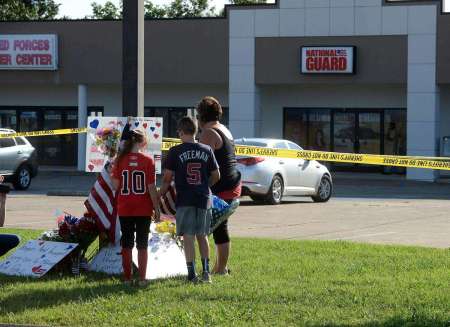
WASHINGTON, July 16, 2015 – Four Marines were killed and another service member was wounded in two separate shootings in Chattanooga, Tennessee, today, military officials confirmed.
The shootings took place at a Network Operations Support Center, operated by the Navy, and at an armed forces recruiting center, officials said.
Names of the deceased will be released after their families are notified, officials said, adding that the Defense Department is working with local and federal authorities.
The Network Operations Support Center is used by Navy and Marine Corps personnel, and is often referred to as a “reserve center,” Navy officials said. It provides training and readiness support for reserve-component personnel to enable them to support the needs of the Navy and Marine Corps.
‘Devastating and Senseless’
“The tragedy in Chattanooga is both devastating and senseless,” Navy Secretary Ray Mabus said in a statement. “On behalf of the entire Department of the Navy family, I offer my deepest condolences to the families of those killed and wounded in service to our nation during this incident.”
As the investigation unfolds, he added, the priority will be to take care of the families of those affected.
“I’d like to express my gratitude to the first responders on the scene whose prompt reaction was critical to stopping this individual from inflicting further violence,” Mabus said. “Though we can never fully prevent attacks like this, we will continue to investigate, review and guard against future vulnerabilities and do everything in our power to safeguard the security of our service members and their families.”

Army Announces Force Structure and Stationing Decisions
The Department of the Army announced today force structure decisions and stationing plans for the reduction of the regular Army from 490,000 to 450,000 soldiers. The reduction of force structure will occur in fiscal years 2016 and 2017; the reduction of 40,000 end strength will be completed by the end of fiscal year 2018, and will be accompanied by the reduction of 17,000 Department of the Army civilian employees. These cuts will impact nearly every Army installation, both in the continental United States and overseas.
As part of these reductions, the number of regular Army brigade combat teams, the basic deployable units of maneuver in the Army, will continue to reduce from a wartime high of 45 to 30 by the end of fiscal year 2017. The Army will convert both the 3rd Brigade Combat Team, 3rd Infantry Division at Fort Benning, Georgia and the 4th Airborne Brigade Combat Team, 25th Infantry Division at Joint Base Elmendorf-Richardson, Alaska into smaller unitsmaneuver battalion task forcesby the end of fiscal year 2017. While brigade combat teams consist of approximately 4,000 soldiers, these battalion task forces will be comprised of approximately 1,050 soldiers.
Additionally, the 2nd Brigade Combat Team, 25th Infantry Division will remain a brigade combat team, but will convert its primary maneuver platform. Currently, 2nd Brigade Combat Team, 25th Infantry Division is a Stryker brigade combat team, however, it will become an infantry brigade combat team without Stryker combat vehicles. Additionally, the Army is analyzing a proposal to use the brigade combat team’s current Stryker equipment to convert an Army National Guard brigade combat team in the Pacific Northwest to a Stryker configuration. The Army selected these brigade combat teams for reorganization based on a variety of factors including strategic requirements and the inherent military value of the installations where they are based. The force structure decisions announced today best posture a smaller Army to meet global commitments.
“Budget constraints are forcing us to reduce the Total Army,” said Lt. Gen. Joseph Anderson, Army deputy chief of staff, G-3/5/7. “These were very difficult decisions to make as all of our installations and their communities offer tremendous value to our Army and the nation. In the end, we had to make decisions based on a number of strategic factors, to include readiness impacts, mission command and cost.”
If the fiscal-caps of the 2011 Budget Control Act caps, commonly referred to as sequestration, are not addressed, the Army’s end-strength will be further reduced to 420,000 soldiers by the end of fiscal year 2019. This will result in a cumulative loss of 150,000 soldiers from the regular Army a 26 percent cut over a seven year period. The resulting force would be incapable of simultaneously meeting current deployment requirements and responding to the overseas contingency requirements of the combatant commands.
For more information on this release, please contact Lt. Col. Joe Buccino at 703-697-5662, Office of the Chief of Public Affairs, Office of the Secretary of the Army.